| Rodrigues day gecko | |
|---|---|
) | |
| Museum specimen | |
Scientific classification  | |
| Kingdom: | Animalia |
| Phylum: | Chordata |
| Class: | Reptilia |
| Order: | Squamata |
| Family: | Gekkonidae |
| Genus: | Phelsuma |
| Species: | †P. edwardnewtoni |
| Binomial name | |
| †Phelsuma edwardnewtoni J. Vinson & J.-M. Vinson, 1969 | |
| Synonyms[1] | |
| |
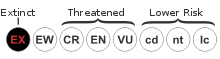
The Rodrigues day gecko (Phelsuma edwardnewtoni) is an extinct species of day gecko, a lizard in the family Gekkonidae. The species lived on the island of Rodrigues, where it typically inhabited forests and dwelt in trees. The Rodrigues day gecko fed on insects and nectar.
Etymology
The specific name, edwardnewtoni, is in honor of British colonial administrator and ornithologist Edward Newton.[2]
Taxonomy
)
The Rodrigues day gecko is now extinct. It was originally described as Phelsuma newtoni by Boulenger in 1884, also spelt Phelsuma newtonii by Boulenger in 1885. However, because this scientific name was also used as a synonym for Phelsuma gigas, Vinson & Vinson changed the specific name to edwardnewtoni in 1969.
Description
P. edwardnewtoni was one of the largest day geckos. It reached a total length (including tail) of about 23 cm (9.1 in). Earlier investigators describe the animal as being quite common. However, this species has not been sighted since 1917, in spite of thorough searches in the 1960s and 1970s on Rodrigues and all offshore islets. Today, only five preserved specimens remain, three of which are in The Natural History Museum in London, the two others being in the Paris Natural History Museum. These specimens have been preserved in alcohol and show a thick-bodied, robust Phelsuma. The body colour has been described as bright green with bright blue spots on the back. The underside of the tail was whitish-yellow. The chin had a deep yellow colour.
Behaviour and ecology
The species Phelsuma edwardnewtoni inhabited Rodrigues Island and its surrounding islets. P. edwardnewtoni was observed on coconut trees and other palms. Its habitat has been largely destroyed by humans and introduced animals such as cats and rats, which may have been the main cause of its extinction.
These day geckos fed on various insects and other invertebrates. They also liked to lick soft, sweet fruit, pollen and nectar.
P. edwardnewtoni was documented as being unafraid of humans. It was quite tame and would even eat fruit from one's hand. Leguat described the behaviour as follows:
The Palmtrees and Plantanes are always loaden with Lizards about a foot long, the Beauty of which is very Extraordinairy; some of them are blue, some black, some green, some red, some grey, and the colour of each the most lively and bright of any of its kind. Their common Food is the Fruit of the Palm-Trees. They are not mischievous, and so Tame, that they often come and eat the Melons on our Tables, and in our Presence, and even in our Hands; they serve for Prey to some Birds, specially the Bitterns. When we beat 'em down from the Trees with a Pole, these Birds wou'd come and devour them before us, tho' we did our utmost to hinder them; and when we offered to oppose them, they came on still after their Prey, and still followed us when we endeavoured to defend them.[3]
It can also be noted that the behavior of this species was most likely very similar to other island dwelling day geckos such as the Madagascar Giant Day Gecko and Standing's Day Gecko which share a very similar niche as this species.
References
- ^ "Phelsuma edwardnewtoni ". The Reptile Database. www.reptile-database.org.
- ^ Beolens, Bo; Watkins, Michael; Grayson, Michael (2011). The Eponym Dictionary of Reptiles. Baltimore: Johns Hopkins University Press. xiii + 296 pp. ISBN 978-1-4214-0135-5. (Phelsuma edwardnewtoni, p. 80).
- ^ Cheke AS, Hume JP (2008). Lost Land of the Dodo: an Ecological History of Mauritius, Réunion & Rodrigues. New Haven and London: T. & A.D. Poyser. ISBN 978-0-7136-6544-4.
Further reading
- Boulenger GA (1884). "Note upon a large Lizard of the Genus Phelsuma, from Rodriguez, sent by Mr. J.C. O'Halloran". Proc. Zool. Soc. London 1884: 1-2. ("Phelsuma newtoni [sic]", new species).
- Boulenger GA (1885). Catalogue of the Lizards in the British Museum (Natural History). Second Edition. Volume I. Geckonidæ ... London: Trustees of the British Museum (Natural History). (Taylor and Francis, printers). xii + 436 pp. + Plates I-XXXII. ("Phelsuma newtonii [sic]", pp. 212–213 + Plate XVII).
- Henkel F-W, Schmidt W (1995). Amphibien und Reptilien Madagaskars, der Maskarenen, Seychellen und Komoren. Stuttgart: Ulmer. ISBN 3-8001-7323-9.
- McKeown, Sean (1993). The general care and maintenance of day geckos. Lakeside, California: Advanced Vivarium Systems.