)
The Hamangia culture is a Late Neolithic archaeological culture of Dobruja (Romania and Bulgaria) between the Danube and the Black Sea and Muntenia in the south. It is named after the site of Baia-Hamangia, discovered in 1952 along Golovița Lake.[1]
Genesis and successor
The Hamangia culture began around 5250/5200 BC and lasted until around 4550/4500 BC. It was absorbed by the expanding Boian culture in its transition towards the Gumelniţa.[2] Its cultural links with Anatolia suggest that it was the result of a recent settlement by people from Anatolia, unlike the neighbouring cultures, which appear descended from earlier Neolithic settlement.[3]
Art
The Hamangia culture attracted and attracts the attention of many art historians because of its exceptional clay figures.
Pottery
Painted vessels with complex geometrical patterns based on spiral-motifs are typical. The shapes include: bowls and cylindric glasses (most with of them with arched walls). They are decorated with dots, straight parallel lines and zig-zags, which make Hamangia pottery very original.
Figurines
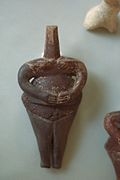
Pottery figurines are normally extremely stylized and show standing naked faceless women with emphasized breasts and buttocks. Two figurines known as "The Thinker" and "The Sitting woman" are considered masterpieces of Neolithic art.
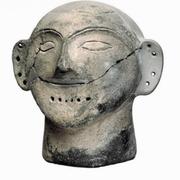
Life-size clay head, 4500–4000 BC

Male and female figurines

Female figurine, "The Sitting Woman"

Male figurine, "The Thinker"
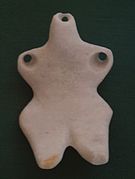
Figurine
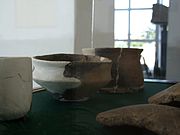
Pottery
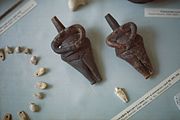
Figurines
)
)
)
)
)
)
)
)
Settlements
Settlements consist of rectangular houses with one or two rooms, built of wattle and daub, sometimes with stone foundations (in Durankulak). They are normally arranged on a rectangular grid and may form small tells. Settlements are located along the coast, at the coast of lakes, on the lower and middle river-terraces, sometimes in caves.
Inhumation
Crouched or extended inhumation in cemeteries. Grave-goods tend to be without pottery in Hamangia I. Grave-goods include flint, worked shells, bone tools and shell-ornaments.
Important sites
- The Durankulak lake settlement commenced on a small island, approximately 7000 BC and around 4700/4600 BC the stone architecture was already in general use and became a characteristic phenomenon that was unique in Europe.
- Cernavodă, the necropolis where the famous statues "The Thinker" and "The Sitting Woman" were discovered
- The eponymous site of Baia-Hamangia, discovered in 1953 along Lake Golovița, close to the Black Sea coast, in the Romanian province of Dobrogea.
See also
- Cycladic art
- Varna culture
- Vinča culture
- Cucuteni-Trypillia culture
- Old Europe
- History of Bulgaria
- Prehistoric Romania
- Prehistoric art
- List of Stone Age art
References
- ^ Dumitru Berciu, Cultura Hamangia. București: Editura Academiei Republicii Socialiste România (1966).
- ^ Vladimir Slavchev, Monuments of the final phase of Cultures Hamangia and Savia on the territory of Bulgaria, Revista Pontica vols. 37-38 (2004-2005), pp. 9-20.
- ^ M. Nica, Unitate şi diversitate în culturile neolitice de la dunărea de jos = Unity and diversity of Neolithic cultures along the lower Danube, Revista Pontica vol. 30 (1997), pp. 105-116.
External links
) Media related to Hamangia culture at Wikimedia Commons
Media related to Hamangia culture at Wikimedia Commons