| Camellia reticulata | |
|---|---|
) | |
Scientific classification  | |
| Kingdom: | Plantae |
| Clade: | Tracheophytes |
| Clade: | Angiosperms |
| Clade: | Eudicots |
| Clade: | Asterids |
| Order: | Ericales |
| Family: | Theaceae |
| Genus: | Camellia |
| Species: | C. reticulata |
| Binomial name | |
| Camellia reticulata | |
| Synonyms[2] | |
| |
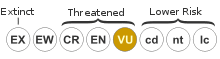
)
Camellia reticulata (syn. C. heterophylla)[3] is a species of flowering plant in the tea family Theaceae, native to southwestern China, in Yunnan Province. The wild populations are restricted to mixed mountain forest in western and central Yunnan.[1]
It is a loosely branched shrub or small tree, which can grow up to 10 to 15 meters (33 to 49 ft) in height.[4] The leaves are elliptic to oblong-elliptic, 5–11 centimetres (2.0–4.3 in) long and 4–5.5 centimetres (1.6–2.2 in) wide. The flowers are 7–10 centimetres (2.8–3.9 in) in diameter, or larger in some cultivars, soft-pink to deep-pink and rarely almost white, with 5–7 petals or more in some cultivars,[5] and are produced in sub-terminal or axillary positions on the branch.[5] The fruit is a light brown, three-segmented capsule, about 5 centimetres (2.0 in) in diameter that ripens in the fall[6] This Camellia is very susceptible to cold weather and has a late blooming season; August through October in the southern hemisphere and March through May in the northern hemisphere.[7]
Symbolism and uses
Camellia reticulata is the floral emblem of Yunnan. It has a long history of cultivation, both for tea oil and for its ornamental value.[8]
In 1820, Captain Richard Rawes of the East Indiaman Warren Hastings imported the first reticulata to England, (named 'Captain Rawes'). It remained the only known reticulata cultivated in Europe for over a century.[9]
References
- ^ a b IUCN Red List of Threatened Species
- ^ "The Plant List: A Working List of All Plant Species". Retrieved 21 April 2015.
- ^ Species R-S Archived 2006-08-21 at the Wayback Machine
- ^ "The Huntington:The Camellia Garden". Archived from the original on 2014-02-24. Retrieved 2016-09-11.
- ^ a b Tianlu Min and Bruce Bartholomew (2007), "Camellia reticulata", Flora of China online, 12, retrieved 21 April 2015
- ^ "A Fresh Look at Camellia reticulata". Articles — Pacific Horticulture. Pacific Horticulture. January 2001. Retrieved 5 April 2016.
- ^ "Gardenia:All you need to know". Retrieved 16 June 2017.
- ^ "Camellias from China". Rhododendron Dell — Plant collections. Dunedin Botanic Garden. 8 Mar 2012. Archived from the original on 22 April 2016. Retrieved 5 April 2016.
- ^ Camellias.pics: Photographic nomenclature of Camellias. Accessed 2 September 2016.