)
Note: This page uses common physics notation for spherical coordinates, in which is the angle between the z axis and the radius vector connecting the origin to the point in question, while is the angle between the projection of the radius vector onto the x-y plane and the x axis. Several other definitions are in use, and so care must be taken in comparing different sources.[1]


Cylindrical coordinate system
Vector fields
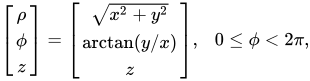
Vectors are defined in cylindrical coordinates by (ρ, φ, z), where
- ρ is the length of the vector projected onto the xy-plane,
- φ is the angle between the projection of the vector onto the xy-plane (i.e. ρ) and the positive x-axis (0 ≤ φ < 2π),
- z is the regular z-coordinate.
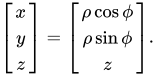
(ρ, φ, z) is given in cartesian coordinates by:
)
or inversely by:
Any vector field can be written in terms of the unit vectors as:

The cylindrical unit vectors are related to the cartesian unit vectors by:
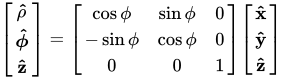
Note: the matrix is an orthogonal matrix, that is, its inverse is simply its transpose.
Time derivative of a vector field
To find out how the vector field A changes in time we calculate the time derivatives. For this purpose we use Newton's notation for the time derivative (). In cartesian coordinates this is simply:


However, in cylindrical coordinates this becomes:

We need the time derivatives of the unit vectors. They are given by:

So the time derivative simplifies to:

Second time derivative of a vector field
The second time derivative is of interest in physics, as it is found in equations of motion for classical mechanical systems. The second time derivative of a vector field in cylindrical coordinates is given by:

To understand this expression, we substitute A = P, where p is the vector (\rho, θ, z).
This means that .

After substituting we get:

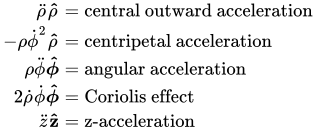
In mechanics, the terms of this expression are called:
Spherical coordinate system
Vector fields
Vectors are defined in spherical coordinates by (r, θ, φ), where
- r is the length of the vector,
- θ is the angle between the positive Z-axis and the vector in question (0 ≤ θ ≤ π), and
- φ is the angle between the projection of the vector onto the X-Y-plane and the positive X-axis (0 ≤ φ < 2π).
(r, θ, φ) is given in Cartesian coordinates by:

or inversely by:
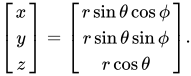
Any vector field can be written in terms of the unit vectors as:

The spherical unit vectors are related to the cartesian unit vectors by:
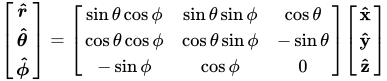
Note: the matrix is an orthogonal matrix, that is, its inverse is simply its transpose.
So the cartesian unit vectors are related to the spherical unit vectors by:
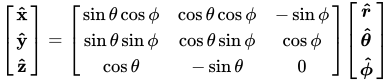
Time derivative of a vector field
To find out how the vector field A changes in time we calculate the time derivatives. In cartesian coordinates this is simply:

However, in spherical coordinates this becomes:

We need the time derivatives of the unit vectors. They are given by:
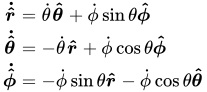
So the time derivative becomes:

See also
- Del in cylindrical and spherical coordinates for the specification of gradient, divergence, curl, and laplacian in various coordinate systems.