)
)
A straw hat is a brimmed hat that is woven out of straw or straw-like materials from different plants or synthetics.[1] The hat is designed to protect the head from the sun and against heatstroke, but straw hats are also used in fashion as a decorative element or a uniform.
Materials
Commonly used fibers are:[2]
- Wheat straw: (Milan straw, Tuscan, Leghorn),
- Rye straw: used for the traditional bryl straw hats popular among the peasants of Belarus, southwestern Russia and Ukraine.
- Toquilla straw: flexible and durable fiber, which is often made into hats in Ecuador, but popularly known as Panama hats.[3]
- Buntal/ Parabuntal straw: from unopened Palm leaves or stems of the Buri Palm,
- Baku straw: 1x1 woven, made from the young stalks of the Talipot palm from Malabar and Ceylon,
- Braided hemp,
- Raffia,
- Shantung straw: made from high performance paper which is rolled into a yarn to imitate straw,[4] historically it was made of buntal[2]
- Toyo straw: cellophane coated Washi,
- Bangora straw: made from a lower grade of Washi,
- Paperbraids: made from different paper strands from Viscose from different Plants (Swiss Paglinastraw[5]), (Silkpaper, Rice paper),
- Sisal/ Parasisal (2x2 woven sisal),
- Seagrass (Xian),
- Visca straw: an artificial straw made by spinning viscose in a flat filament capable of being braided, woven, or knitted and used especially for women's hats,
- Rush straw: a thick, stiff straw, used to manufacture inexpensive casual sun hats, made from rush grass (Juncus effesus, Juncus polycephalus), from the bulrushtypes sedge grass (Schoenoplectus lacustris, Cyperus papyrus,[6][7] Typha (Typha domingensis, syn. Thypha angustata) (bulrush or cattail)}[8] and other types seashore rushgrass (Sporobolus virginicus) or reed[9][10]
- Jute,
- Abacá: (for Sinamay hats)
- Ramie,
- Artificial, synthetic straw, PP straw: made from Polypropylene, Polyethylene[11] or from different blends from Acrylic, PP, PE, Polyester, Ramie and Paper[12]
- other straw fibers that are mostly used in Asian conical hats are made from different palms (Corypha, Rattan, Trachycarpus, Phoenix), grasses Cane, Bamboo[13] and rice straw (Kasa (hat))
- Chip straw:[14] from White pine, Lombardy poplar, or English willow, has historically been used,[15] but has become less common.
Manufacture
There are several styles of straw hats, but all of them are woven using some form of plant fibre.[16][17] Many of these hats are formed in a similar way to felt hats; they are softened by steam or by submersion in hot water, and then formed by hand or over a hat block. Finer and more expensive straw hats have a tighter and more consistent weave. Since it takes much more time to weave a larger hat than a smaller one, larger hats are more expensive.
History
Straw hats have been worn in Europe and Asia since after the Middle Ages during the summer months, and have changed little between the medieval times and today. Many are to be seen in the famous calendar miniatures of the Très Riches Heures du Duc de Berry, worn by all classes, but mostly by men.
)
The mokorotlo, a local design of a straw hat, is the national symbol of the Basotho and Lesotho peoples, and of the nation of Lesotho. It is also displayed on the license plates of that country.
President Theodore Roosevelt helped popularize the straw Panama hat during his visit to the Panama Canal. Roosevelt used his natural ability to drum up publicity by posing for a series of photos at the Panama Canal construction site in 1906. Photos of his visit showed a strong, rugged leader dressed crisply in light-colored suits and stylish straw fedoras.[18]
Types of straw hats
- Boater hat — a formal straw hat with a flat top and brim.
- Buntal hat — a semi-formal or informal traditional straw hat from the Philippines made from buntal fiber
- Conical hat — the distinctive hat worn primarily by farmers in Southeast Asia
- Panama hat — a fine and expensive hat made in Ecuador.
- Salakot — a traditional conical or pointed rounded hat made usually made from rattan from the Philippines. It can also be made from gourds, tortoiseshell, or other fibers and weaving materials.
Gallery

Buntal hat from the Philippines
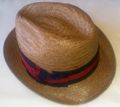
Straw fedora hat (1960s) from the International Hat Company, in the United States
.jpg)
A child wearing a straw hat. Seen here in a 1928 professional image taken in South Shields, England
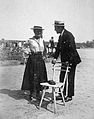
An image taken in 1912 depicting a man and woman wearing straw hats

Conical Asian hat in Myanmar

Young Woman in Sun Hat
)
)
)
)
.jpg'))
)
)
)
Arts
Artwork produced during the Middle Ages shows, among the more fashionably dressed, possibly the most spectacular straw hats ever seen on men in the West, notably those worn in the Arnolfini Portrait of 1434 by Jan van Eyck (tall, stained black) and by Saint George in a painting by Pisanello of around the same date (left). In the middle of the 18th century, it was fashionable for rich ladies to dress as country girls with a low crowned and wide brimmed straw hat to complete the look.[19]
_-_WGA7691.jpg)
Arnolfini Portrait (detail) by Jan van Eyck
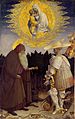
Virgin and Child with Saints George and Anthony by Pisanello
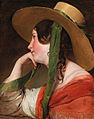
Mädchen mit Strohhut by Friedrich von Amerling
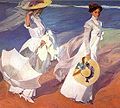
Walk on the Beach by Joaquín Sorolla
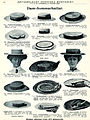
Ad for ladies' straw hats
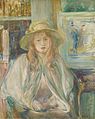
Fillette au chapeau de paille, by Berthe Morisot (1892).
_-_WGA7691.jpg'))
)
)
)
)
)
See also
- Straw Hat Riot
References
- ^ Hatatorium: An Essential Guide for Hat Collectors ISBN 978-0-984-78590-2 p. 18
- ^ a b A Dictionary of Costume and Fashion:, Mary Brooks Picken, Courier Corporation, 24.07.2013
- ^ "Types of Straws Used in Hat Making | Ultrafino". Ultrafino. 30 November 2017. Retrieved 7 December 2017.
- ^ The Fairchild Encyclopedia of Menswear, Mary Lisa Gavenas, Fairchild Books, 2008, P. 327
- ^ Paglinastroh Retrieved 03.14.2016
- ^ Rush straw Retrieved 03-18-2016
- ^ Bulrush hat Retrieved 03-18-2016
- ^ Typha hat Retrieved 03-19-2016
- ^ Reed hat Retrieved 03-18-2016
- ^ Historical Common Names of Great Plains Plants Volume I: Historical Names , Elaine Nowick, Lulu.com, 01.10.2014, P. 355
- ^ Information for use in determining whether to continue designation of certain headwear of straw as articles eligible for duty-free treatment under the generalized system of preferences:, Jackie Worrell, United States International Trade Commission, 1982, P. 5
- ^ PP Straw Retrieved 03-16-2016
- ^ Hats and Headwear around the World: A Cultural Encyclopedia:, Beverly Chico, ABC-CLIO, 03.10.2013, P. 115, 259
- ^ Hatatorium: An Essential Guide for Hat Collectors, Brenda Grantland, P. 56
- ^ Chip straw Retrieved 03-16-2016
- ^ Our Economic World: A Study of the World's Natural Resources and Industries ISBN 978-0-412-57640-9 p. 302
- ^ woodsofshropshire.co.uk
- ^ "President Theodore Roosevelt's Legendary Panama Canal Fashion | Ultrafino". Ultrafino. 29 September 2017. Retrieved 7 December 2017.
- ^ "The Hat Story". British Hat Guild. 2003. Archived from the original on 10 May 2012. Retrieved 14 March 2016.