.jpg'))
The parochet (Hebrew: פרוכת) (also paroches; from the Aramaic parokta meaning "curtain" or "screen" [1]) is the curtain that covers the Aron Kodesh (Torah Ark) containing the Sifrei Torah (Torah scrolls) in a synagogue.
The parochet symbolizes the curtain that covered the Ark of the Covenant, based on Exodus 40:21. "He brought the ark into the Tabernacle and placed the screening dividing curtain so that it formed a protective covering before the Ark...".[2]
In most synagogues, the parochet which is used all year round is replaced during the High Holy Days with a white one.
The term parochet is used in the Bible to describe the curtain that separated the Kodesh Hakodashim (Holy of Holies) from the main hall called "Hekhal" [3] of the Temple in Jerusalem. Its use in synagogues is a reference to the centrality of the Temple to Jewish worship.
The U. Nahon Museum of Italian Jewish Art in Jerusalem houses the oldest surviving parochet, dating to 1572.[4]
Gallery

Parochet of the Synagoge in Mühlhausen
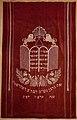
Original parochet from Great Lublin Maharshal's synagogue from 1926, today in synagogue in Bielsko-Biała, Poland.
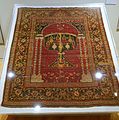
Early 17th century parochet from Cairo, Egypt
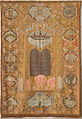
1698 linen and silk parochet from Venice, Italy

Parochet in the Hurva Synagogue in Jerusalem
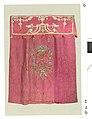
Parochet from 1797, Jewish Museum of Switzerland.
)
)
)
)
)
)