Neuwied | |
|---|---|
) Neuwied | |
) Flag ) Coat of arms | |
Location of Neuwied within Neuwied district 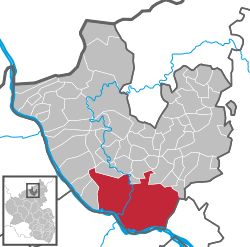 | |
)  Neuwied ) Neuwied | |
| Coordinates: 50°25′43″N 7°27′41″E / 50.42861°N 7.46139°E | |
| Country | Germany |
| State | Rhineland-Palatinate |
| District | Neuwied |
| Subdivisions | 13 Stadtteile |
| Government | |
| • Lord mayor | Jan Einig[1] |
| Area | |
| • Total | 86.50 km2 (33.40 sq mi) |
| Elevation | 60 m (200 ft) |
| Population (2019-12-31)[2] | |
| • Total | 64,765 |
| • Density | 750/km2 (1,900/sq mi) |
| Time zone | UTC+01:00 (CET) |
| • Summer (DST) | UTC+02:00 (CEST) |
| Postal codes | 56501–56567 |
| Dialling codes | 02631 und 02622 |
| Vehicle registration | NR |
| Website | www |
)
Neuwied (German: [nɔɪ̯.ˈviːt] ) is a town in the north of the German state of Rhineland-Palatinate, capital of the District of Neuwied. Neuwied lies on the east bank of the Rhine, 12 km northwest of Koblenz, on the railway from Frankfurt am Main to Cologne. The town has 13 suburban administrative districts: Heimbach-Weis, Gladbach, Engers, Oberbieber, Niederbieber, Torney, Segendorf, Altwied, Block, Irlich, Feldkirchen, Heddesdorf and Rodenbach. The largest is Heimbach-Weis, with approximately 8000 inhabitants.
Founded by Count Frederick of Wied in 1653 as residence of the Lower County of Wied, Neuwied was located near the village of Langendorf, destroyed during the Thirty Years' War (1618–1648). It grew rapidly due to its religious tolerance. Among those who sought refuge here was a colony of Moravian Brethren.
Near Neuwied, one of the largest Roman castra on the Rhine has been excavated by archeologists.
In April 1797 the French, under General Louis Lazare Hoche, defeated the Austrians near Neuwied, this being their first decisive success in the French Revolutionary Wars.
Neuwied is the native town of paternal ancestors of John D. Rockefeller, traced to the 16th century and possible French Huguenot refugees. His father's line emigrated to the North American colonies, arriving in New York in 1710, the year of a massive immigration of nearly 2800 Palatine Germans refugees, whose transportation costs from London were covered by Queen Anne's British government. Neuwied was also the birthplace of William of Wied, who briefly held the title of King of Albania in 1914.
Geography
Parts of the 86.5 square kilometre area are divided into the suburban districts of:
- Altwied
- Block
- Engers
- Feldkirchen
- Gladbach
- Heimbach-Weis
- Irlich
- Niederbieber
- Oberbieber
- Rodenbach
- Segendorf
- Torney
The core of Neuwied and the former village of Heddesdorf, which belonged to the municipality before these districts were added, are not listed as districts themselves.
Since the inner city of Neuwied is situated on a former bed of the river Rhine, it is at great risk of flooding. It is one of very few towns in the region protected by flood-prevention levees, a source of friction with communities downstream.
Neuwied is twinned with the London Borough of Bromley.
Politics
The 2019 municipal council elections led to the following distribution of seats: CDU (15), SPD (12), Greens (7), AfD (5), FWG (3), FDP (2), The Left (2), Ich tu's (2).
Notable residents
)
To 1800
- Hermann of Wied (1477–1552), archbishop-elector of Cologne, reformer
- Gotthard Rockenfeller (1590), emigrated to the (later) United States of America and ancestor of John D. Rockefeller, founder of the oil imperium in the second part of the 19th century
- Johan Willem Crolius (1700-1753), Grandfather of Clarkson Crolius famous NYC potter
- Louis-François Metra (1738–1804), 18th-century French journalist
- De Beaunoir (1746–1823), 18th-century French playwright
- David Roentgen (1743–1807), cabinetmaker
- Peter Kinzing (1745–1816), watchmaker and mechanic
- Johannes Baptista von Albertini (1769–1831), Bishop of Moravian Church
- Prince Maximilian of Wied-Neuwied (1782–1867), naturalist, botanist, ethnologist
1801–1850
- Philipp Wilhelm Wirtgen (1806–1870), botanist
- Hermann, Prince of Wied (1814–1864), Prince of Wied
- Elisabeth of Wied (1843–1916), Queen of Romania, poet, pseudonym Carmen Sylva
- William, Prince of Wied (1845–1907), Prince of Wied, Officer and politician
1851–1900
- Ferdinand Hueppe (1852–1938), Co-founder of the DFB and sports medicine
- Paul Reichard (1854–1938), African researchers
- Friedrich von Ingenohl (1857–1933), Admiral, commander of the imperial High Seas Fleet in World War I
- Ferdinand Siegert (1865–1946), pediatrician
- Carl von Moers (1871–1957), horse rider – Eventing and Dressage
- Carl Einstein (1885–1940), writer, art historian, and critic
- Friedrich Wolf (1888–1953), doctor and writer
- Wilhelm, Prince of Albania (1876-1945), sovereign prince of Albania
1901–1950
- Walter Kaiser (1907–1982), professional footballer
- Horst Siebert (1938–2009), economist
- Klaus Rudolf Werhand (1938–2009), Blacksmith and Art Metal Sculptor
- Renate Freund (born 1939), writer
1951–present
- Monika Kropshofer (born 1952), painter and photographer
- Jörg Bewersdorff (born 1958), mathematician
- Thomas J. Kinne (born 1961), television personality and quiz player
- Helmut Dieser (born 1962), Roman Catholic bishop in Aachen
- Ulf Mark Schneider (born 1965), Manager and current CEO of Nestlé
- Martin Werhand (born 1968), publisher, editor and writer
- Ferris MC (born 1973), musician, rapper and actor
- Christian Ulmen (born 1975), entertainer and actor
- Simon Kirch (born 1979), track and field athlete
- Mike Rockenfeller (born 1983), race car driver
- Tobias Nickenig (born 1984), professional footballer
- Tobias Hegewald (born 1989), racing driver
- Hasan Ali Kaldırım (born 1989), Turkish footballer
- Anna-Lena Friedsam (born 1994), tennis player
- Isaac Bonga (born 1999), basketball player
Population
Originally there were only a few thousand people living in Neuwied with the number not growing significantly because of wars and famines. With the industrialization in the 19th century the number of inhabitants increased from 5,600 in 1831 to 18,000 in 1905.
By 1970 the figure had grown to 31,400 and following a major realignment incorporating several communities within the town, it jumped to 63,000.
As of 30 June 2005 there were officially 66,455 people living in Neuwied.
Infrastructure
)
Neuwied is connected to the German network of Bundesstraßen (national routes) (here: B9, B42 and B256). The Autobahnen (motorways) A3, A48 and A61 are quickly reachable from Neuwied.
Public transport
Within the bounds of Neuwied are two railway stations, Neuwied and Engers on the Right Rhine line, and a third station is under consideration by the state agency for northern commuter railway services (SPNV Nord), which is responsible for the service on the railway lines connecting to Koblenz Hauptbahnhof in the south and Köln Hauptbahnhof in the north. Via either of those stations, the German high-speed rail network and the InterCity network are accessible. Daytime service includes
- a Deutsche Bahn hourly semi-fast train (Regional-Express), the Rhein-Erft-Express, running Koblenz-Engers-Neuwied-Cologne-Mönchengladbach and back,
- and a Deutsche Bahn hourly all-stops service (Regionalbahn) Koblenz-Neuwied-Cologne-Stommeln(-Mönchengladbach) and back, which is also available in the evening hours.
- A VIAS hourly semi-fast train (StadtExpress) Neuwied-Koblenz-Lahnstein-Wiesbaden(-Frankfurt) and back, running also in evening hours.
It takes about 15 to 20 minutes to travel to Koblenz while Cologne is about 70 to 80 minutes away, Mainz 90 to 120 minutes, direct connection to Frankfurt is around 150 minutes, sometimes faster when changing to the IC/ICE network.
Public transport within Neuwied relies on a bus network, offering (depending on line) 20, 30 or 60-minute schedules, the majority of lines are served by Transdev.
All public transport (road and rail) is integrated into the Verkehrsverbund Rhein-Mosel public transport association. Tickets are valid for all service, restricted by time and fare zones. For more information on timetables see [1].
Twin Towns
Neuwied is twinned with:
 Bromley, England, United Kingdom.
 Drom HaSharon Regional Council, Israel.
 Güstrow, Mecklenburg-Vorpommern, Germany.
 Suqian, China.


See also
- Synagogue District, Neuwied
Notes
- ^ https://www.swr.de/swraktuell/rp/koblenz/stichwahl-fuer-den-oberbuergermeister-der-stadt-neuwied/-/id=1642/did=20440180/nid=1642/uoqprj/index.html
- ^ "Bevölkerungsstand 2019, Kreise, Gemeinden, Verbandsgemeinden". Statistisches Landesamt Rheinland-Pfalz (in German). 2020.
References
 This article incorporates text from a publication now in the public domain: Chisholm, Hugh, ed. (1911). "Neuwied". Encyclopædia Britannica. 19 (11th ed.). Cambridge University Press. p. 450.
 This article incorporates text from a publication now in the
 External links
 Media related to Neuwied at Wikimedia Commons
 Neuwied travel guide from Wikivoyage
- . New International Encyclopedia. 1905.
)
)