Lines of Zahn are a characteristic of thrombi[1] that appear particularly when formed in the heart or aorta. They have visible and microscopic alternating layers (laminations) of platelets mixed with fibrin, which appear lighter and darker layers of red blood cells.[2] Their presence implies thrombosis at a site of rapid blood flow that happened before death. In veins or smaller arteries, where flow is not as constant, they are less apparent.
They are named after German–Swiss pathologist Friedrich Wilhelm Zahn.[3]
Lines of Zahn are only seen when thrombi is formed in flowing blood as it is a distinguishing marker between ante-mortem and postmortem thrombi formation.
Additional images
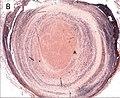
Thrombus showing circumferential lines of Zahn.
.jpg)
Recent pulmonary thromboembolus exhibiting prominent lines of Zahn. The pale areas consist of fibrin and platelets; the red areas consist of erythrocytes.
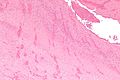
Low magnification micrograph showing laminations in a thrombus in a fatal pulmonary embolism. H&E stain.
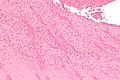
Intermediate magnification micrograph showing laminations in a thrombus in a fatal pulmonary embolism. H&E stain.
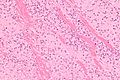
High magnification micrograph showing laminations in a thrombus in a fatal pulmonary embolism. H&E stain.
)
.jpg'))
)
)
)
References
- ^ "Atherosclerosis".
- ^ Lee R, Adlam D, Clelland CA, Channon KM (2012). "Lines of Zahn in coronary artery thrombus". Eur Heart J. 33 (9): 1039. doi:10.1093/eurheartj/ehs028. PMID 22345124.
- ^ Stegman, JK, ed. (2006), Stedman's Medical Dictionary (28th ed.), Baltimore, MD: Lippincott, Williams, & Wilkins
Further reading
- Kumar, V. et al. (2005). Hemodynamic Disorders, Thromboembolic Disease, and Shock. Robbins and Cotran Pathologic Basis of Disease. 7th edition. Elsevier Saunders: Pennsylvania.
- Simon S. Cross (ed.). "Chapter 6: Thrombosis, Embolism and Infarction". Underwood's pathology : a clinical approach (PDF) (6th ed.). Edinburgh: Churchill Livingstone. ISBN 0702046728.