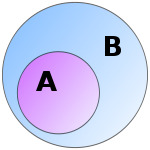
In mathematics, if A is a subset of B, then the inclusion map (also inclusion function, insertion,[1] or canonical injection) is the function ι that sends each element x of A to x, treated as an element of B:

A "hooked arrow" (U+21AA ↪ RIGHTWARDS ARROW WITH HOOK)[2] is sometimes used in place of the function arrow above to denote an inclusion map; thus:

(However, some authors use this hooked arrow for any embedding.)
This and other analogous injective functions[3] from substructures are sometimes called natural injections.
Given any morphism f between objects X and Y, if there is an inclusion map into the domain ι : A → X, then one can form the restriction f ι of f. In many instances, one can also construct a canonical inclusion into the codomain R → Y known as the range of f.
Applications of inclusion maps
Inclusion maps tend to be homomorphisms of algebraic structures; thus, such inclusion maps are embeddings. More precisely, given a substructure closed under some operations, the inclusion map will be an embedding for tautological reasons. For example, for some binary operation ⋆, to require that

is simply to say that ⋆ is consistently computed in the sub-structure and the large structure. The case of a unary operation is similar; but one should also look at nullary operations, which pick out a constant element. Here the point is that closure means such constants must already be given in the substructure.
Inclusion maps are seen in algebraic topology where if A is a strong deformation retract of X, the inclusion map yields an isomorphism between all homotopy groups (that is, it is a homotopy equivalence).
Inclusion maps in geometry come in different kinds: for example embeddings of submanifolds. Contravariant objects (which is to say, objects that have pullbacks; these are called covariant in an older and unrelated terminology) such as differential forms restrict to submanifolds, giving a mapping in the other direction. Another example, more sophisticated, is that of affine schemes, for which the inclusions

and

may be different morphisms, where R is a commutative ring and I is an ideal of R.
See also
References
- ^ MacLane, S.; Birkhoff, G. (1967). Algebra. Providence, RI: AMS Chelsea Publishing. p. 5. ISBN 0-8218-1646-2.
Note that “insertion” is a function S → U and "inclusion" a relation S ⊂ U; every inclusion relation gives rise to an insertion function.
- ^ "Arrows – Unicode" (PDF). Unicode Consortium. Retrieved 2017-02-07.
- ^ Chevalley, C. (1956). Fundamental Concepts of Algebra. New York, NY: Academic Press. p. 1. ISBN 0-12-172050-0.