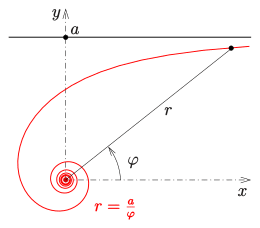
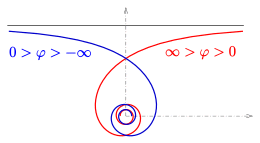
A hyperbolic spiral is a plane curve, which can be described in polar coordinates by the equation

of a hyperbola. Because it can be generated by a circle inversion of an Archimedean spiral, it is called reciproke spiral, too.[1][2]
Pierre Varignon first studied the curve in 1704.[2] Later Johann Bernoulli and Roger Cotes worked on the curve as well.
In cartesian coordinates
the hyperbolic spiral with the polar equation
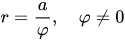
can be represented in Cartesian coordinates (x = r cos φ, y = r sin φ) by

The hyperbola has in the rφ-plane the coordinate axes as asymptotes. The hyperbolic spiral (in the xy-plane) approaches for φ → ±∞ the origin as asymptotic point. For φ → ±0 the curve has an asymptotic line (see next section).
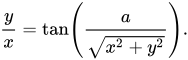
From the polar equation and φ = a/r, r = √x2 + y2 one gets a representation by an equation:
Geometric properties
Asymptote
Because

the curve has an asymptote with equation y = a.
Polar slope
)
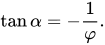
From vector calculus in polar coordinates one gets the formula tan α = r′/r for the polar slope and its angle α between the tangent of a curve and the tangent of the corresponding polar circle.
For the hyperbolic spiral r = a/φ the polar slope is
Curvature
The curvature of a curve with polar equation r = r(φ) is
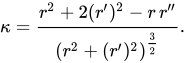
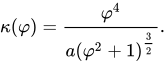
From the equation r = a/φ and the derivatives r′ = −a/φ2 and r″ = 2a/φ3 one gets the curvature of a hyperbolic spiral:
Arc length
The length of the arc of a hyperbolic spiral between (r(φ1), φ1) and (r(φ2), φ2) can be calculated by the integral:
![{\displaystyle {\begin{aligned}L&=\int _{\varphi _{1}}^{\varphi _{2}}{\sqrt {\left(r^{\prime }(\varphi )\right)^{2}+r^{2}(\varphi )}}\,d\varphi =\cdots \\&=a\int _{\varphi _{1}}^{\varphi _{2}}{\frac {\sqrt {1+\varphi ^{2}}}{\varphi ^{2}}}\,d\varphi \\&=a\left[-{\frac {\sqrt {1+\varphi ^{2}}}{\varphi }}+\ln \left(\varphi +{\sqrt {1+\varphi ^{2}}}\right)\right]_{\varphi _{1}}^{\varphi _{2}}.\end{aligned}}}](http://img.tfd.com/wiki/math/da/21a80ceb06fb95bfde4e98c04ebc702924d2f00c.svg)
Sector area
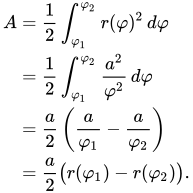
The area of a sector (see diagram above) of a hyperbolic spiral with equation r = a/φ is:
Inversion
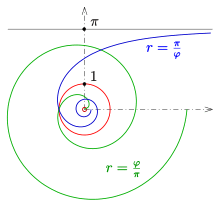
The inversion at the unit circle has in polar coordinates the simple description: (r, φ) ↦ (1/r, φ).
The image of an Archimedean spiral r = φ/a with a circle inversion is the hyperbolic spiral with equation r = a/φ. At φ = a the two curves intersect at a fixed point on the unit circle.
The osculating circle of the Archimedean spiral r = φ/a at the origin has radius ρ0 = 1/2a (see Archimedean spiral) and center (0, ρ0). The image of this circle is the line y = a (see circle inversion). Hence the preimage of the asymptote of the hyperbolic spiral with the inversion of the Archimedean spiral is the osculating circle of the Archimedean spiral at the origin.
- Example: The diagram shows an example with a = π.
Central projection of a helix
)
Consider the central projection from point C0 = (0, 0, d) onto the image plane z = 0. This will map a point (x, y, z) to the point d/d − z(x, y).
The image under this projection of the helix with parametric representation

is the curve
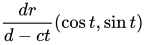
with the polar equation

which describes a hyperbolic spiral.
For parameter t0 = d/c the hyperbolic spiral has a pole and the helix intersects the plane z = d at a point V0. One can check by calculation that the image of the helix as it approaches V0 is the asymptote of the hyperbolic spiral.
References
- ^ Bowser, Edward Albert (1880), An Elementary Treatise on Analytic Geometry: Embracing Plane Geometry and an Introduction to Geometry of Three Dimensions (4th ed.), D. Van Nostrand, p. 232
- ^ a b Lawrence, J. Dennis (2013), A Catalog of Special Plane Curves, Dover Books on Mathematics, Courier Dover Publications, p. 186, ISBN 9780486167664.
- Hans-Jochen Bartsch, Michael Sachs: Taschenbuch mathematischer Formeln für Ingenieure und Naturwissenschaftler, Carl Hanser Verlag, 2018, ISBN 3446457070, 9783446457072, S. 410.
- Kinko Tsuji, Stefan C. Müller: Spirals and Vortices: In Culture, Nature, and Science, Springer, 2019, ISBN 3030057984, 9783030057985, S. 96.
- Pierre Varignon: Nouvelle formation de Spirales – exemple II, Mémoires de l’Académie des sciences de l’Institut de France, 1704, pp. 94–103.
- Friedrich Grelle: Analytische Geometrie der Ebene, Verlag F. Brecke, 1861 hyperbolische Spirale, S. 215.
- Jakob Philipp Kulik: Lehrbuch der höhern Analysis, Band 2, In Commiss. bei Kronberger u. Rziwnatz, 1844, Spirallinien, S. 222.