| Generalissimus of the Soviet Union Генералиссимус Советского Союза | |
|---|---|
) Proposed uniform epaulette | |
| Country |  Soviet Union Soviet Union |
| Service branch | ) Soviet Armed Forces Soviet Armed Forces |
| Rank | General officer |
| NATO rank code | OF-11 |
| Non-NATO rank | Six-star rank |
| Formation | Proposed |
| Next higher rank | None |
| Next lower rank | |
Generalissimus of the Soviet Union (Russian: Генералиссимус Советского Союза; Generalissimus Sovyétskogo Soyuza) was a military rank created on 27 June 1945,[1] following the tradition of the Imperial Russian Army (the rank in question was held by four people: Aleksei Shein, Prince Alexander Danilovich Menshikov, Duke Anthony Ulrich of Brunswick (reportedly – not confirmed) and Count Alexander Suvorov). It was proposed for but rejected by Joseph Stalin following World War II. It was the highest military rank in the Soviet Union.
Overview
This military rank was specifically created for and proposed to Joseph Stalin but he rejected it. However, according to Stalin biographer Robert Service, Stalin regretted allowing himself the ostentatious military title, and asked Winston Churchill to continue to refer to him as a marshal instead.[2] Stalin also rejected any kind of distinctions between his military rank and the other Soviet marshals, and kept using the original Marshal of the Soviet Union insignia and uniform like the other Soviet marshals.[3]
The matter about Generalissimus of the Soviet Union was mentioned again after the war, when a draft of a decree about the Soviet military ranks was presented to Stalin. Then, General Andrey Khrulyov – director of the General Department of Logistics – was given the task to design the uniform of the Soviet Generalissimus for Stalin to use in the victory parade on 9 May 1947. The uniform was finished and presented to Stalin one week before the parade.
After examining it, Stalin again expressed dissatisfaction. Then he took hold of the decree about the Generalissimus rank and declared: "I will never sign this decree. The Soviet Red Army only has Marshal as its highest rank." Thereafter, the subject of new rank was never raised again.[3]
Fabricated samples were rejected by Stalin, who considered them to be too luxurious and old-fashioned. Currently they are stored in the Museum of the Great Patriotic War located in Moscow at Poklonnaya Gora.
Proposed shoulder insignia
Below are proposed designs of the shoulder insignia of Generalissimus of the Soviet Union.
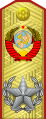
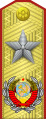


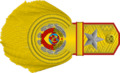
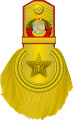
This insignia was a part of the uniform which was presented to, but rejected by, Stalin.
)
)
)
)
)
)
| Sequence of ranks | ||
|---|---|---|
| Lower rank: Marshal of the Soviet Union (Маршал Советского Союза) | ) Generalissimus of the Soviet Union (Генералиссимус Советского Союза) | Higher rank: None (highest) |
| Admiral of the fleet of the Soviet Union (Адмирал Флота Советского Союза) | ||
See also
- Generalissimo
- Military ranks of the Soviet Union
- Marshal of the Soviet Union
- List of Russian field marshals
References
- ^ Scott, Harriet Fast; Scott, William F. (11 July 2019). The Soviet Art Of War: Doctrine, Strategy, And Tactics. Routledge. p. Appendix. ISBN 978-1-000-30563-0. Retrieved 11 December 2020.
- ^ Service, Robert (2005). Stalin: A Biography. Cambridge: Harvard University Press. p. 548. ISBN 978-0-674-01697-2.
- ^ a b Shtemenko, Sergey M (1985). Генеральный штаб во время войны. 2-е издание-е. (in Russian). Moscow: Воениздат. pp. 587–588. ISBN 5-9713-0069-5.
External links
- Generalissimus of the Soviet Union (in Russian)