Esquiule Eskiula | |
|---|---|
) The church of Esquiule | |
Location of Esquiule 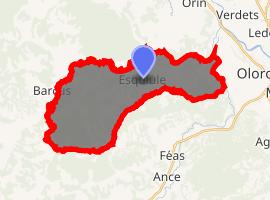 | |
)  Esquiule ) Esquiule | |
| Coordinates: 43°11′41″N 0°42′25″W / 43.1947°N 0.7069°W | |
| Country | France |
| Region | Nouvelle-Aquitaine |
| Department | Pyrénées-Atlantiques |
| Arrondissement | Oloron-Sainte-Marie |
| Canton | Oloron-Sainte-Marie-1 |
| Government | |
| • Mayor (2020–2026) | Maryse Artigau[1] |
| Area 1 | 28.58 km2 (11.03 sq mi) |
| Population (Jan. 2017)[2] | 537 |
| • Density | 19/km2 (49/sq mi) |
| Time zone | UTC+01:00 (CET) |
| • Summer (DST) | UTC+02:00 (CEST) |
| INSEE/Postal code | 64217 /64400 |
| Elevation | 190–661 m (623–2,169 ft) (avg. 198 m or 650 ft) |
| 1 French Land Register data, which excludes lakes, ponds, glaciers > 1 km2 (0.386 sq mi or 247 acres) and river estuaries. | |
Esquiule (Basque: Eskiula) is a commune in the Pyrénées-Atlantiques department in south-western France.
It is located in the former province of Béarn. It stands out as an outpost of the Basque area of Soule, the village being historically Basque speaking. It has often played host to the carnivalesque performances known as maskaradak and its inhabitants arranged and performed one traditional theatre piece of Soule (pastorala) under the title Madalena de Jaureguiberry in 2000.
See also
References
- ^ "Répertoire national des élus: les maires". data.gouv.fr, Plateforme ouverte des données publiques françaises (in French). 2 December 2020. Retrieved 7 December 2020.
- ^ "Populations légales 2017". INSEE. Retrieved 6 January 2020.
External links