)
A catkin or ament is a slim, cylindrical flower cluster (a spike), with inconspicuous or no petals, usually wind-pollinated (anemophilous) but sometimes insect-pollinated (as in Salix). They contain many, usually unisexual flowers, arranged closely along a central stem that is often drooping. They are found in many plant families, including Betulaceae, Fagaceae, Moraceae, and Salicaceae.
Occurrence
Catkin-bearing plants include many trees or shrubs such as birch, willow, hickory, sweet chestnut, and sweetfern (Comptonia).
In many of these plants, only the male flowers form catkins, and the female flowers are single (hazel, oak), a cone (alder), or other types (mulberry). In other plants (such as poplar), both male and female flowers are borne in catkins.
In Britain, they can be seen in January or February, when many trees are bare for winter. They can even occur in December.[1]
Evolution
For some time, catkins were believed to be a key synapomorphy among the proposed Hamamelididae, also known as Amentiferae (i.e., literally plants bearing aments). Based on molecular phylogeny work, it is now believed that Hamamelididae is a polyphyletic group.[2][3] This suggests that the catkin flower arrangement has arisen at least twice independently by convergent evolution, in Fagales and in Salicaceae.[4] Such a convergent evolution raises questions about what the ancestral inflorescence characters might be and how catkins did evolve in these two lineages.
Etymology
)
The word catkin is a loanword from the Middle Dutch katteken, meaning "kitten" (compare also German Kätzchen). This name is due either to the resemblance of the lengthy sorts of catkins to a kitten's tail, or to the fine fur found on some catkins.[5][6] Ament is from the Latin amentum, meaning "thong" or "strap".[7]
Gallery
- Catkins in Fagales
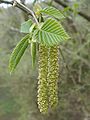
Male catkins of hop-hornbeam (Ostrya carpinifolia)

Young male catkins of hazel (Corylus avellana)

Mature male catkins of hazel (Corylus avellana)
)
)
)
.jpg'))
- Catkins in Salicaceae
)
)
)
References
- ^ January 2015, 30. "An early catkin year". www.bbc.com.
- ^ Savolainen, V., M. W. Chase, S. B. Hoot, C. M. Morton, D. E. Soltis, C. Bayer, M. F. Fay, A. Y. De Bruijn, S. Sullivan, and Y.-L. Qiu. 2000. Phylogenetics of flowering plants based on combined analysis of plastid atpB and rbcL gene sequences. Systematic Biology 49:306-362.
- ^ Soltis, D. E. et alii. (28 authors). 2011. "Angiosperm phylogeny: 17 genes, 640 taxa". American Journal of Botany 98(4):704-730. doi:10.3732/ajb.1000404
- ^ Cronk Q. C. B., Needham I., and Rudall P. J. 2015. Evolution of catkins: inflorescence morphology of selected Salicaceae in an evolutionary and developmental context. Frontiers in Plant Science. 2015; 6: 1030. doi:10.3389/fpls.2015.01030
- ^ "Catkin", Oxford English Dictionary (Second ed.), 1989, retrieved 30 November 2009
- ^ "Zoekresultaten". www.etymologiebank.nl.
- ^ "Ament", Oxford English Dictionary (Second ed.), 1989, retrieved 30 November 2009