| White-eared pocket mouse | |
|---|---|
Scientific classification  | |
| Kingdom: | Animalia |
| Phylum: | Chordata |
| Class: | Mammalia |
| Order: | Rodentia |
| Family: | Heteromyidae |
| Genus: | Perognathus |
| Species: | P. alticolus |
| Binomial name | |
| Perognathus alticolus Rhoads, 1894 | |
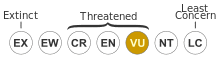
The white-eared pocket mouse (Perognathus alticolus) is a species of rodent in the family Heteromyidae. It is endemic to the San Bernardino Mountains and the Tehachapi Mountains of southern California in the United States.[1] There are two subspecies of P. alticolus in California, P. a. alticolus and P. a. inexpectatus, both of which are considered species of special concern by the California Department of Fish and Wildlife.[2]
Characteristics
White-eared pocket mice are native to the San Bernardino Mountains and Tehachapi Mountains in California. They are named after there feature of having white or yellowish hair on the external portion of there ear. Within the genus Perognathus, P. alticolus is on the medium to large size. The back of the mouse is yellowish brown with blackish lines and the underbelly of it is white. The tail typically has two or three colors. The under portion is white and the top portion matches the back of the mouse with the tip of the tail being black or ducky in color. The body length, tail length, hind foot length and length of many other feature of the male is much larger than the female. This means they are sexually dimorphic based on size.[2]
Anatomy
| Body Feature Length Measurements | Average (mm) | Range (mm) |
|---|---|---|
| Total Body Length | 155 | 142-177 |
| Tail | 80 | 70-95 |
| Hind Foot | 21 | 19-32 |
| Ear | 6 | 5-6 |
| Greatest Length of Cranium | 24.1 | 22.5-26.1 |
| Nasal | 9.2 | 8.2-11.0 |
| Maxillary | 10.6 | 8.0-13.9 |
| Mandible | 12.8 | 11.9-14.2 |
| Maxillary Toothrow | 3.5 | 8.0-13.9 |
Sexually Dimorphic Measurements
| Average Measurement (mm) | Males | Females |
|---|---|---|
| Total Length | 163.6 | 149.5 |
| Body Length | 77.6 | 72.5 |
| Tail Length | 21.9 | 20.7 |
| Ear Length | 5.9 | 5.6 |
| Greatest Depth of Cranium | 8.2 | 8.0 |
| Greatest With of Cranium | 12.9 | 12.4 |
Distribution
White-eared pocket mice are only found in California. They can be found in Kern county, Los Angeles county, San Bernardino County and the San Bernardino Mountains. They inhabit arid shrubs and forests at elevations greater than 1,500 meters or 4,921 feet.[2]
Ecology
P. alticolus can be found in Ponderosa pine forest and open pine forest with bracken ferns Pteridium aquilinum, in wooded habitats that contain Joshua tree and pinyon-juniper woodland, and in grasslands with scattered Ponderosa pine. They can also be found in chaparral , coastal-sage, and areas with an abundance of Salsola .[2]
Sources
- ^ a b Naylor, L. & Roach, N. 2017. Perognathus alticola. The IUCN Red List of Threatened Species 2017: e.T16631A22224213. http://oldredlist.iucnredlist.org/details/16631/0 Downloaded on 17 September 2017.
- ^ a b c d e f g Best, Troy L. (2 June 1994). "Perognathus alticolus". Mammalian Species (463): 1. doi:10.2307/3504273.