| Jamaican tangelo | |
|---|---|
) | |
| Jamaican tangelo | |
| Scientific classification | |
| Kingdom: | |
| (unranked): | Angiosperms |
| (unranked): | |
| (unranked): | |
| Order: | |
| Family: | |
| Genus: | |
| Species: | C. reticulata × paradisi |
| Binomial name | |
| Citrus reticulata × paradisi | |
The Jamaican tangelo, also known by proprietary names ugli /ˈʌɡli/ fruit, uglifruit, and uniq fruit, is a citrus fruit that arose on the island of Jamaica through the natural hybridization of a tangerine or orange with a grapefruit (or pomelo), and is thus a tangelo.[1] The original tree is believed to have been a hybrid formed from the Seville orange, the grapefruit and the tangerine families.[2]
As a hybrid species, it is usually represented as Citrus reticulata × paradisi.[3]
Discovery
This tangelo was a natural hybrid, having arisen spontaneously like the grapefruit,[1] near Brown's Town, Jamaica, where it is mainly grown today.[4] It was discovered growing wild in or about 1917, then passed through several generations of budwood grafting, selecting for fewer seeds. It was exported by 1934 to Canada and England, and in 1942 to the United States.[5] 'UGLI' is a registered trademark of Cabel Hall Citrus Limited, under which it markets the fruit,[6] the name being a variation of the word "ugly", which refers to the fruit's unsightly appearance, with rough, wrinkled, greenish-yellow rind, wrapped loosely around the orange pulpy citrus inside.[3]
Description
The light-green surface blemishes turn orange when the fruit is at its peak ripeness. The Jamaican tangelo is usually slightly larger than a grapefruit (but this varies) and has fewer seeds. The flesh is very juicy and tends toward the sweet side of the tangerine rather than the bitter side of its grapefruit lineage, with a fragrant rind.
The taste is often described as sourer than an orange and less bitter than a grapefruit, however, and is more commonly guessed to be a lemon–tangerine hybrid. The fruit is seasonal from December to April. It is distributed in Europe and the United States between November and April,[4] and is on occasion available from July to September.
Gallery
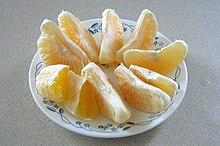
Jamaican tangelo, peeled and sectioned
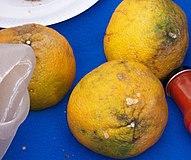
Roundish version
)
)
References
- ^ a b Grapefruit: a fruit with a bit of a complex in Art Culinaire (Winter 2007)
- ^ "About Us – UGLI". Retrieved April 24, 2020.
- ^ a b Bastyra, Judy, and Julia Canning. A Gourmet's Guide to Fruit. Los Angeles: HP Books, 1989. Pg. 52.
- ^ a b "Where to look – UGLI". Retrieved February 13, 2012.
- ^ Pierre Laszlo (2007). Citrus: A History. Chicago: University of Chicago Press. p. 198.
- ^ "About Us – UGLI". Retrieved February 13, 2012.