Palamós | |
|---|---|
Municipality | |
) View of Palamós from the beach of Sant Antoni de Calonge | |
) Coat of arms | |
)  Palamós Location in Catalonia ) Palamós Palamós (Spain) | |
| Coordinates: 41°51′00″N 3°07′45″E / 41.85000°N 3.12917°E | |
| Country |  Spain Spain |
| Community |  Catalonia Catalonia |
| Province | Girona |
| Comarca | Baix Empordà |
| Government | |
| • Mayor | Lluis Puig Martorell (2015)[1] |
| Area | |
| • Total | 14.0 km2 (5.4 sq mi) |
| Elevation | 30 m (100 ft) |
| Population (2018)[3] | |
| • Total | 17,898 |
| • Density | 1,300/km2 (3,300/sq mi) |
| Demonym(s) | Catalan: Palamosí (m) Palamosina (f) |
| Website | www |
Palamós (Catalan pronunciation: [pələˈmos]) is a town and municipality in the Mediterranean Costa Brava, located in the comarca of Baix Empordà, in the province of Girona, Catalonia, Spain.
History
Palamos was founded and recognised as a village on 3 December 1279 by 'Pere el Gran', 'Comte de Barcelona' (Peter III of Aragon). He wanted to found a new port on the coast as the previous royal port in the region at Torroella de Montgrí on the River Ter had silted up.
Evidence of an early settlement lies around 1.7 kilometres (1.1 mi) north-east of the town, on a rocky promontory at the north end of Platja de Castell beach. The Castell de la Fosca is a stone settlement of the Iberian Indigetes people which dates from the 6th century BC.
Features
Palamós is located at the northern end of a large bay, which is popular for sailing, swimming and windsurfing. The town is by-passed by the C31 which connects the coastal towns of the central Costa Brava with Girona. Palafrugell lies 8.5 km to the north and Castell-Platja d'Aro 7 km to the south.
The town is a major port (with the closure of Sant Feliu the only commercial harbour in the Province of Girona) with one of the last remaining fishing fleets on this part of the Mediterranean coast. It is famous for the locally caught prawns from Palamós (Catalan: gambes).[4]
The town's major economic activities until the second half of the 20th century were fishing and cork manufacturing. In the sixties, however, the town saw a rapid growth of tourism. The architecture of Palamos itself remained relatively unchanged with most development focused to the south at Sant Antoni de Calonge which now merges with Palamos. The town's nightlife is focused on the old port which is surrounded by bars and restaurants.
The town is home to Palamós CF the local football club. They share their ground, the Estadi Palamós Costa Brava with the small, but over-achieving club UE Llagostera, as the club's stadium, Estadi Municipal de Llagostera, didn't meet the LFP criteria.
The first evidence of human settlement is the Dolmen de Montagut, [3] on the top of Montagut hill, which only has 3 slabs in its original state and the remains of a tomb that these it covered. Remains [4] of an Indiget (Iber) settlement are preserved at Punta de Castell, the second most important Indiget city after Ullastret.
The port of the current Palamós was used during the pre-Roman and Roman eras, [5] but it went into disuse until Peter III in 1277 commissioned the purchase of the castle of Sant Esteve, built on Roman remains, or bought land which gave Astruc Ravaia to develop a new population center from the Pobla Charter. On August 28 and September 3 and 4, 1285, during the reign of Peter III, near the Formigues Islands, the Catalan stolen, commanded by Admiral Roger de Llúria, won the French from Philip III the Ardit.
It was the birthplace of Frederic Pujulà i Vallès who was a pioneer of Esperanto literature.
Gallery
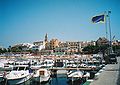
Palamós
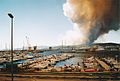
The port; in the background a forest fire near Platja d’Aro
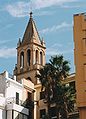
The church Santa Maria del Mar
)
)
)
)
See also
- Prawns from Palamós
References
- ^ "Ajuntament de Palamós". Generalitat of Catalonia. Retrieved 2015-11-13.
- ^ "El municipi en xifres: Palamós". Statistical Institute of Catalonia. Retrieved 2015-11-23.
- ^ Municipal Register of Spain 2018. National Statistics Institute.
- ^ [1]
- Panareda Clopés, Josep Maria; Rios Calvet, Jaume; Rabella Vives, Josep Maria (1989). Guia de Catalunya, Barcelona: Caixa de Catalunya. ISBN 84-87135-01-3 (Spanish). ISBN 84-87135-02-1 (Catalan).
External links
- Official website
- Government data pages (in Catalan)