| Lonicera involucrata | |
|---|---|
) | |
| Lonicera involucrata var. ledebourii | |
Scientific classification  | |
| Kingdom: | Plantae |
| Clade: | Tracheophytes |
| Clade: | Angiosperms |
| Clade: | Eudicots |
| Clade: | Asterids |
| Order: | Dipsacales |
| Family: | Caprifoliaceae |
| Genus: | Lonicera |
| Species: | L. involucrata |
| Binomial name | |
| Lonicera involucrata (Richardson) Banks ex Spreng. | |
| Synonyms[1] | |
| |
Lonicera involucrata, the bearberry honeysuckle, bracted honeysuckle, twinberry honeysuckle, Californian Honeysuckle,[2] twin-berry, or black twinberry, is a species of honeysuckle native to northern and western North America, from southern Alaska east across boreal Canada to Quebec, and south through the western United States to California, and to Chihuahua in northwestern Mexico. It grows at elevations from sea level to 2,900 m.[3][4][5]
It is a large shrub that can grow 0.5–5 m high, with shoots with a quadrangular cross-section. The leaves are elliptic, to oval-shaped, 3–16 cm long and 2–8 cm broad; they are hairy along the margins and on the underside, and have a distinctive abruptly acuminate tip. The flowers are yellow, tubular, hairy, 1–2 cm long, and are monoecious; they are produced in pairs subtended by a pair of reddish basal bracts 2–4 cm across. The fruit is a 6–12 mm diameter black berry containing several small seeds,[4][5][6] ripening in mid-to-late summer.[7]
There are two varieties:[5][8][9]
- Lonicera involucrata var. involucrata. Most of the species' range, except as below; in California only in the Sierra Nevada. Leaves thin; flowers yellow.
- Lonicera involucrata var. ledebourii (Eschsch.) Jeps. Coastal California and southern Oregon. Leaves thick, leathery; flowers tinged orange to red outside.
Cultivation and uses
It is often used as an ornamental plant. It is resistant to air pollution, and can be kept in a large garden.[10] The berries may be edible or very unpalatable, or even poisonous.[11] Some bears eat them, but the plants are not abundant enough to be a staple food of wildlife.[12]
Images
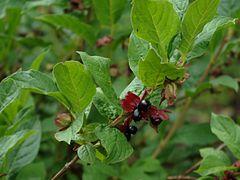
In fruit

Variety involucrata
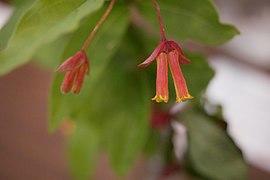
Twinberry
)
)
)
References
- ^ "The Plant List: A Working List of All Plant Species". Retrieved 7 December 2014.
- ^ "BSBI List 2007". Botanical Society of Britain and Ireland. Archived from the original (xls) on 2015-01-25. Retrieved 2014-10-17.
- ^ "Lonicera involucrata". Germplasm Resources Information Network (GRIN). Agricultural Research Service (ARS), United States Department of Agriculture (USDA). Retrieved 8 January 2018.
- ^ a b Plants of British Columbia: Lonicera involucrata
- ^ a b c Jepson Flora: Lonicera involucrata
- ^ BorealForest: Lonicera involucrata
- ^ Reiner, Ralph E. (1969). Introducing the Flowering Beauty of Glacier National Park and the Majestic High Rockies. Glacier Park, Inc. p. 58.
- ^ Jepson Flora: Lonicera involucrata var. involucrata
- ^ Jepson Flora: Lonicera involucrata var. ledebourii
- ^ Blanchan, N. (2005). Wild Flowers Worth Knowing. Project Gutenberg Literary Archive Foundation.
- ^ Darris, D. (2011). "Plant fact sheet for twinberry honeysuckle (Lonicera involucrata)" (PDF). USDA Natural Resources Conservation Service, Corvallis, OR.
- ^ Whitney, Stephen (1985). Western Forests (The Audubon Society Nature Guides). New York: Knopf. p. 427. ISBN 0-394-73127-1.