| Deputy Prime Minister of New Zealand | |
|---|---|
) | |
) | |
) Grant Robertson since 6 November 2020 | |
| Department of the Prime Minister and Cabinet | |
| Style | The Honourable |
| Member of |
|
| Reports to | Prime Minister of New Zealand |
| Appointer | Governor-General of New Zealand |
| Term length | At Her Majesty's pleasure |
| Formation | 13 November 1954 |
| First holder | Sir Keith Holyoake |
| Salary | $334,734 (NZD)[1] |
| Website | www.beehive.govt.nz |
The deputy prime minister of New Zealand (Māori: Te Pirimia Tuarua o Aotearoa) is the second most senior member of the Cabinet of New Zealand. The officeholder usually deputises for the prime minister at official functions. The current deputy prime minister is Grant Robertson.
The role existed on an informal basis for as long as the office of prime minister/premier has existed, but the office of "deputy prime minister" was formally established as a ministerial portfolio in 1954. This means that Keith Holyoake is considered as the first deputy prime minister.
Appointment and duties
Generally, the position is held by the deputy leader of the largest party, but now that the MMP electoral system makes coalitions more likely, the role may instead go to the leader of a junior party. This occurred with Winston Peters, leader of New Zealand First,[2] and Jim Anderton, leader of the Alliance.[3] The current deputy prime minister, Grant Robertson of the Labour Party, has the role even though his party's deputy leader is Kelvin Davis. After the 2020 election, Davis turned down the position,[4] and Robertson was appointed instead.[5]
The post of deputy prime minister was formally established in 1954.[N 1] Eighteen individuals have held the position (two of them doing so twice) and of those people: Holyoake, Marshall, Watt, Muldoon, Palmer, Clark and English have eventually served as prime minister.[N 2]
The duties of the deputy prime minister are to act on behalf of the prime minister in his or her absence overseas or on leave. The deputy prime minister has always been a member of the Cabinet, and has always held at least one substantive portfolio. If the prime minister were to die, become incapacitated or resign, the Governor-General would normally appoint the Deputy Prime Minister as Prime Minister on an interim basis until the governing party elects a new leader, but is not obligated to do so.
Little scholarly attention has focused on deputy prime ministers in New Zealand or elsewhere. In 2009, an article by Steven Barnes appeared in Political Science where nine 'qualities' of deputy prime ministership were identified: temperament; relationships with their Cabinet and caucus; relationships with their party; popularity with the public; media skills; achievements as Deputy Prime Minister; relationship with the Prime Minister; leadership ambition; and method of succession.[6] Barnes conducted a survey of journalists, academics, and former members of parliament to rank New Zealand's deputy prime ministers since 1960. Across the nine deputy prime minister 'qualities', Don McKinnon achieved the number one ranking, followed by Brian Talboys, Michael Cullen, and John Marshall. In a second 'overall' ranking, Cullen was ranked number one, followed by Talboys, McKinnon, and Marshall. Jim Anderton, Winston Peters, and Bob Tizard were ranked lowest in both sections of the survey.[6]
List of deputy prime ministers of New Zealand
- Key
Labour National NZ First Alliance
| No. | Name | Portrait | Concurrent portfolio(s) | Term of office | Prime Minister | |||
|---|---|---|---|---|---|---|---|---|
| 1 | Keith Holyoake | .jpg')) | Minister of Agriculture | 13 November 1954 | 20 September 1957 | Holland | ||
| 2 | Jack Marshall | ) | Attorney-General Minister of Justice | 20 September 1957 | 12 December 1957 | Holyoake | ||
| 3 | Jerry Skinner | ) | Minister of Agriculture Minister of Lands | 12 December 1957 | 12 December 1960 | Nash | ||
| (2) | Jack Marshall | ) | Minister of Overseas Trade Minister of Industries and Commerce Minister of Labour Minister of Immigration | 12 December 1960 | 9 February 1972 | Holyoake | ||
| 4 | Robert Muldoon | ) | Minister of Finance Minister of Statistics | 9 February 1972 | 8 December 1972 | Marshall | ||
| 5 | Hugh Watt | ) | Minister of Labour Minister of Works | 8 December 1972 | 1 September 1974 | Kirk | ||
| 6 | Bob Tizard | ) | Minister of Finance | 10 September 1974 | 12 December 1975 | Rowling | ||
| 7 | Brian Talboys | ) | Minister of Foreign Affairs Minister of Overseas Trade | 12 December 1975 | 4 March 1981 | Muldoon | ||
| 8 | Duncan MacIntyre | .jpg')) | Minister of Agriculture | 4 March 1981 | 15 March 1984 | |||
| 9 | Jim McLay | .jpg')) | Attorney-General Minister of Justice | 15 March 1984 | 26 July 1984 | |||
| 10 | Geoffrey Palmer | ) | Attorney-General Minister of Justice | 26 July 1984 | 8 August 1989 | Lange | ||
| 11 | Helen Clark | ) | Minister of Labour Minister of Health | 8 August 1989 | 2 November 1990 | Palmer | ||
| Moore | ||||||||
| 12 | Don McKinnon | ) | Minister of Foreign Affairs Minister of Overseas Trade | 2 November 1990 | 16 December 1996 | Bolger | ||
| 13 | Winston Peters | ) | Treasurer | 16 December 1996 | 14 August 1998 | |||
| Shipley | ||||||||
| 14 | Wyatt Creech | ) | Minister of Education Minister of Health | 14 August 1998 | 10 December 1999 | |||
| 15 | Jim Anderton | ) | Minister of Economic Development Minister of Customs | 10 December 1999 | 15 August 2002 | Clark | ||
| 16 | Michael Cullen | ) | Minister of Finance Treasurer Leader of the House | 15 August 2002 | 19 November 2008 | |||
| 17 | Bill English | ) | Minister of Finance Minister for Infrastructure | 19 November 2008 | 12 December 2016 | Key | ||
| 18 | Paula Bennett | ) | Minister of State Services Minister of Police Minister of Tourism | 12 December 2016 | 26 October 2017 | English | ||
| (13) | Winston Peters | ) | Minister of Foreign Affairs Minister for State Owned Enterprises Minister of Racing | 26 October 2017 | 6 November 2020 | Ardern | ||
| 19 | Grant Robertson | ) | Minister of Finance Minister for Infrastructure Minister of Racing Minister for Sport and Recreation | 6 November 2020 | Incumbent | |||
Living former deputy prime ministers
As of February 2021, there are nine living former New Zealand Deputy Prime Ministers, as seen below. The most recent Deputy Prime Minister to die was Jim Anderton (served 1999–2002), on 7 January 2018, aged 79.[7]
- Living former Deputy Prime Ministers of New Zealand
.jpg)
Sir Jim McLay
served 1984
born 1945 (age 75)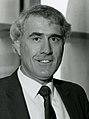
Sir Geoffrey Palmer
served 1984–1989
born 1942 (age 78).jpg)
Helen Clark
served 1989–1990
born 1950 (age 70)
Sir Don McKinnon
served 1990–1996
born 1939 (age 81)
Winston Peters
served 1996–1998;
2017–2020
born 1945 (age 75)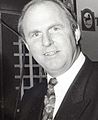
Wyatt Creech
served 1998–1999
born 1946 (age 74)
Sir Michael Cullen
served 2002–2008
born 1945 (age 76)
Sir Bill English
served 2008–2016
born 1961 (age 59)
Paula Bennett
served 2016–2017
born 1969 (age 51)
.jpg'))
)
.jpg'))
)
)
)
)
)
)
Notes
- ^ A few ministers were referred to as "deputy prime minister" before 1954, such as Walter Nash. However, this was a descriptive title and not a formal ministerial portfolio.
- ^ Some lists consider Hugh Watt as a New Zealand Prime Minister. Watt served as acting Prime Minister for seven days from 31 August to 6 September 1972 following the death of Norman Kirk. He is not normally counted in the official numbering of New Zealand Prime Ministers.
References
- ^ "Parliamentary Salaries and Allowances Determination 2017" (PDF). New Zealand Parliament. Retrieved 27 October 2017.
- ^ "Rt Hon Winston Peters". New Zealand First. Archived from the original on 22 June 2017. Retrieved 6 July 2017.
- ^ Vernon Small (7 December 2012). "Labour leader looks to outsiders for deputy". Stuff.co.nz. Retrieved 6 July 2017.
- ^ Whyte, Anna (2 November 2020). "Kelvin Davis says he won't seek Deputy Prime Minister role". TVNZ. Retrieved 6 November 2020.
- ^ "Robertson confirmed as Deputy PM". Otago Daily Times. 2 November 2020. Retrieved 6 November 2020.
- ^ a b Barnes, Steven (2009). "What About Me? Deputy Prime Ministership in New Zealand". Political Science. 61 (1): 33–49. doi:10.1177/00323187090610010401.
- ^ "Jim Anderton dies aged 79". newshub.co.nz. 6 January 2018. Retrieved 6 January 2018.