) ) | |
| Observation data Epoch J2000 Equinox J2000 | |
|---|---|
| Constellation | Puppis |
| Right ascension | 07h 29m 13.83049s[1] |
| Declination | –43° 18′ 05.1597″[1] |
| Apparent magnitude (V) | 3.25[2] |
| Characteristics | |
| Spectral type | K5 III[3] |
| U−B color index | +1.77[2] |
| B−V color index | +1.52[2] |
| Astrometry | |
| Radial velocity (Rv) | +87.7[4] km/s |
| Proper motion (μ) | RA: –59.55[1] mas/yr Dec.: +188.31[1] mas/yr |
| Parallax (π) | 16.84 ± 0.15[1] mas |
| Distance | 194 ± 2 ly (59.4 ± 0.5 pc) |
| Absolute magnitude (MV) | −0.50[5] |
| Orbit[6] | |
| Period (P) | 257.8 days |
| Eccentricity (e) | 0.17 |
| Periastron epoch (T) | 20418.6 |
| Argument of periastron (ω) (secondary) | 349.3° |
| Semi-amplitude (K1) (primary) | 18.6 km/s |
| Details | |
| σ Pup A | |
| Radius | 107[7] R☉ |
| Luminosity | 392[5] L☉ |
| Rotational velocity (v sin i) | 3.0[8] km/s |
| Other designations | |
| Database references | |
| SIMBAD | data |
Sigma Puppis (Sigma Pup, σ Puppis, σ Pup) is a binary star system in the southern constellation of Puppis. It has an apparent visual magnitude of 3.25,[2] which is bright enough to be visible to the naked eye at night from the southern hemisphere. Through a telescope, it appears as a bright, orange-hued star with a nearby white companion.[10] Parallax measurements indicate this star is located at a distance of about 194 light-years (59 parsecs) from Earth.[1]
This is a spectroscopic binary system,[9] consisting of an orbiting pair of stars that have not been individually resolved with a telescope. Their orbital period is 257.8 days and the eccentricity is 0.17.[6] The pair form an eclipsing binary of the Beta Lyrae type and a period of 130.5 days, or one half of their orbital period. The eclipse of the primary component causes a decline of 0.04 magnitudes, while the secondary eclipse reduces the magnitude by 0.03.[11][12]
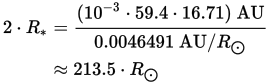
The combined stellar classification is K5 III,[3] which matches the spectrum of a giant star. The measured angular diameter of the primary star is 16.71 ± 2.84 mas.[13] At the estimated distance of this system, this yields a physical size of about 107 times the radius of the Sun.[7] The primary component shows the behavior of a slow irregular variable.[11][12]
In addition to its binary components, Sigma Puppis has a more distant companion that has a matching proper motion, suggesting that it may be gravitationally bound to the binary. This magnitude 8.5[10] star is at an angular separation of 22.4 arcseconds with a position angle of 74° from Sigma Puppis, which is equivalent to a projected separation of 1,200 Astronomical Units.[14] In 1970, American astronomer Olin J. Eggen suggested that Sigma Puppis belonged to a moving group of stars that share a similar motion through space, and thereby a common origin. It served as the eponym for this, the σ Puppis group.[15] The existence of this group was later brought into question.[16]
References
- ^ a b c d e f van Leeuwen, F. (November 2007), "Validation of the new Hipparcos reduction", Astronomy and Astrophysics, 474 (2): 653–664, arXiv:0708.1752, Bibcode:2007A&A...474..653V, doi:10.1051/0004-6361:20078357
- ^ a b c d Johnson, H. L.; et al. (1966), "UBVRIJKL photometry of the bright stars", Communications of the Lunar and Planetary Laboratory, 4 (99), Bibcode:1966CoLPL...4...99J
- ^ a b Houk, Nancy (1978), Michigan catalogue of two-dimensional spectral types for the HD stars, Ann Arbor: Dept. of Astronomy, University of Michigan: distributed by University Microfilms International, Bibcode:1978mcts.book.....H
- ^ Evans, D. S. (June 20–24, 1966), "The Revision of the General Catalogue of Radial Velocities", in Batten, Alan Henry; Heard, John Frederick (eds.), Determination of Radial Velocities and their Applications, Proceedings from IAU Symposium no. 30, University of Toronto: International Astronomical Union, Bibcode:1967IAUS...30...57E
- ^ a b Anderson, E.; Francis, Ch. (2012), "XHIP: An extended hipparcos compilation", Astronomy Letters, 38 (5): 331, arXiv:1108.4971, Bibcode:2012AstL...38..331A, doi:10.1134/S1063773712050015.
- ^ a b Batten, A. H.; Fletcher, J. M.; Mann, P. J. (1978), "Seventh catalogue of the orbital elements of spectroscopic binary systems", Publications of the Dominion Astrophysical Observatory Victoria, 15: 121–295, 150–151, Bibcode:1978PDAO...15..121B
- ^ a b Lang, Kenneth R. (2006), Astrophysical formulae, Astronomy and astrophysics library, 1 (3rd ed.), Birkhäuser, ISBN 3-540-29692-1. The radius (R*) is given by:
- ^ Costa, J. M.; et al. (February 2002), "The tidal effects on the lithium abundance of binary systems with giant component", Astronomy and Astrophysics, 382: 1016–1020, arXiv:astro-ph/0111539, Bibcode:2002A&A...382.1016C, doi:10.1051/0004-6361:20011676
- ^ a b "sig Pup -- Spectroscopic binary", SIMBAD, Centre de Données astronomiques de Strasbourg, retrieved 2010-01-05
- ^ a b Plotner, Tammy; Mann, Terry (2007), The Night Sky Companion: A Yearly Guide to Sky-Watching, Patrick Moore's Practical Astronomy Series, Springer, p. 156, ISBN 0-387-71608-4, retrieved 2012-01-11
- ^ a b Otero, Sebastián A. (October 2007), "New Elements for 54 Eclipsing Binaries", Open European Journal on Variable Stars, 72 (1): 1–19, Bibcode:2007OEJV...72....1O
- ^ a b Samus, N. N.; Durlevich, O. V. (February 12, 2009), GCVS Variability Types and Distribution Statistics of Designated Variable Stars According to their Types of Variability, Sternberg Astronomical Institute, Moscow University, retrieved 2012-04-18
- ^ Richichi, A.; Percheron, I.; Khristoforova, M. (February 2005), "CHARM2: An updated Catalog of High Angular Resolution Measurements", Astronomy and Astrophysics, 431: 773–777, Bibcode:2005A&A...431..773R, doi:10.1051/0004-6361:20042039
- ^ Burnham, Robert (1978), Burnham's celestial handbook: an observer's guide to the universe beyond the solar system, Dover books explaining science, 3 (2nd ed.), Courier Dover Publications, p. 150, ISBN 0-486-23673-0, retrieved 2012-01-11
- ^ Eggen, O. J. (June 1971), "The ζ Herculis, σ Puppis, ∈ Indi, and η Cephei Groups of Old Disk Population Stars", Publications of the Astronomical Society of the Pacific, 83 (493): 251, Bibcode:1971PASP...83..251E, doi:10.1086/129119
- ^ Taylor, B. J. (October 2000), "A statistical analysis of the metallicities of nine old superclusters and moving groups", Astronomy and Astrophysics, 362: 563–579, Bibcode:2000A&A...362..563T