In mathematics, reduced homology is a minor modification made to homology theory in algebraic topology, designed to make a point have all its homology groups zero. This change is required to make statements without some number of exceptional cases (Alexander duality being an example).
If P is a single-point space, then with the usual definitions the integral homology group
- H0(P)
is isomorphic to (an infinite cyclic group), while for i ≥ 1 we have

- Hi(P) = {0}.
More generally if X is a simplicial complex or finite CW complex, then the group H0(X) is the free abelian group with the connected components of X as generators. The reduced homology should replace this group, of rank r say, by one of rank r − 1. Otherwise the homology groups should remain unchanged. An ad hoc way to do this is to think of a 0-th homology class not as a formal sum of connected components, but as such a formal sum where the coefficients add up to zero.
In the usual definition of homology of a space X, we consider the chain complex

and define the homology groups by .

To define reduced homology, we start with the augmented chain complex

where . Now we define the reduced homology groups by
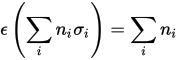
- for positive n and .


One can show that ; evidently for all positive n.


Armed with this modified complex, the standard ways to obtain homology with coefficients by applying the tensor product, or reduced cohomology groups from the cochain complex made by using a Hom functor, can be applied.
References
- Hatcher, A., (2002) Algebraic Topology Cambridge University Press, ISBN 0-521-79540-0. Detailed discussion of homology theories for simplicial complexes and manifolds, singular homology, etc.