A pollinium (plural pollinia) is a coherent mass of pollen grains in a plant that are the product of only one anther, but are transferred, during pollination, as a single unit.[1][2] This is regularly seen in plants such as orchids and many species of milkweeds (Asclepiadoideae). Usage of the term differs: in some orchids two masses of pollen are well attached to one another, but in other orchids there are two halves (with two separate viscidia) each of which is sometimes referred to as a pollinium.[1]
Most orchids have waxy pollinia. These are connected to one or two elongate stipes,[3] which in turn are attached to a sticky viscidium, a disc-shaped structure that sticks to a visiting insect.[2]
Some orchid genera have mealy pollinia. These are tapering into a caudicle (stalk), attached to the viscidium. They extend into the middle section of the column.
The pollinarium is a collective term that means either (1) the complete set of pollinia from all the anthers of a flower, as in Asclepiadoideae, (2) in Asclepiadoideae, a pair of pollinia and the parts that connect them (corpusculum and translator arms), or (3) in orchids, a pair of pollinia with two viscidia and the other connecting parts.[1]
.jpg)
The waxy pollinia of a Phalaenopsis
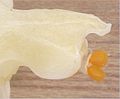
Pollinia of a Phalaenopsis orchid
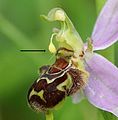
Pollinium of Ophrys apifera
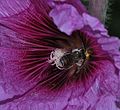
Male bee (Eucera cinnamomea) with pollinium attached to its head

Honeybee on antelope horn (Asclepias asperula) with pollinia attached to legs
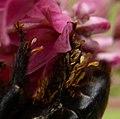
Pollinia of milkweed (Asclepias) on the legs of carpenteer bee (Xylocopa virginica)
.jpg'))
)
)
)
)
)
References
- ^ a b c Beentje, H.; Williamson, J. (2010). The Kew Plant Glossary: an Illustrated Dictionary of Plant Terms. Royal Botanic Gardens, Kew: Kew Publishing.
- ^ a b Hickey, M.; King, C. (2001). The Cambridge Illustrated Glossary of Botanical Terms. Cambridge University Press.
- ^ Kull, T.; Arditti, J. (2002). Orchid Biology VIII: Reviews and Perspectives. 8. Kluwer Academic Publishers. p. 127. ISBN 9781402005800.