| Mount Iriga | |
|---|---|
| Mount Asog | |
) | |
| Highest point | |
| Elevation | 1,196 m (3,924 ft) [1] |
| Prominence | 1,009 m (3,310 ft) |
| Listing | Active volcanoes in the Philippines |
| Coordinates | 13°27′24″N 123°27′24″E / 13.45667°N 123.45667°E [1] |
| Geography | |
.svg.jpg'))  Mount Iriga .svg.jpg')) Mount Iriga | |
| Country | Philippines |
| Region | Bicol Region |
| Province | Camarines Sur |
| City/municipality |
|
| Geology | |
| Age of rock | Quaternary |
| Mountain type | Stratovolcano |
| Volcanic arc/belt | Babuyan (Bashi) Segment of Luzon-Taiwan Arc |
| Last eruption | 1642 |
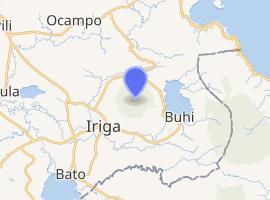 | |
Mount Iriga, also known as Mount Asog, is one of the active volcanoes in the Philippines, in the province of Camarines Sur, in the Philippines.
Mount Iriga is a stratovolcano about a kilometre from Lake Buhi. It rises 1,196 m (3,924 ft) with a base diameter of 10 kilometres (6.2 mi).[1][2] It has a large crater probably formed from a huge eruption.
Iriga erupted in 1628 and 1642.[2] Iriga is generally known for its phreatic explosions. After these eruptions, it remains dormant as of now.
Gallery
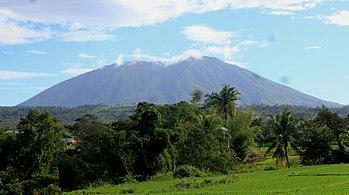
View from San Ramon, Iriga
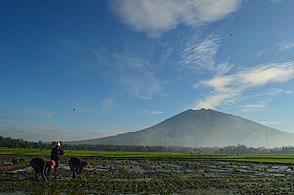
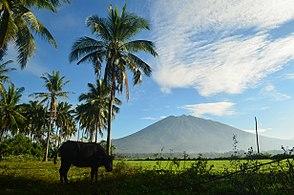
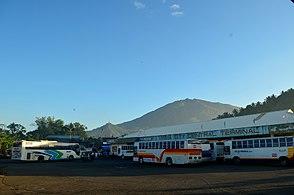
View from Iriga Central Terminal
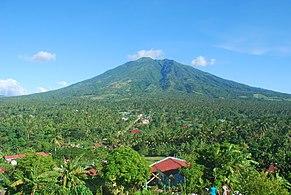
)
)
)
)
)
See also
- List of potentially active volcanoes in the Philippines
- List of inactive volcanoes in the Philippines
- Philippine Institute of Volcanology and Seismology
- Iriga City
References
- ^ a b c "Iriga". Global Volcanism Program. Smithsonian Institution. Retrieved September 17, 2011.
- ^ a b "Mount Iriga". Philippine Institute of Volcanology and Seismology (PHIVOLCS). Archived from the original on September 1, 2011. Retrieved September 17, 2011.
External links
 Media related to Mount Iriga at Wikimedia Commons
)