Book cover 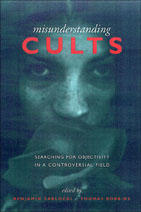 | |
| Editors |
|
|---|---|
| Country | Canada |
| Language | English |
| Subject | Cults |
| Publisher | University of Toronto Press |
Publication date | December 1, 2001 |
| Pages | 496 |
| ISBN | 978-0-8020-8188-9 |
| 306.6 21 | |
| LC Class | BP603 .M575 2001 |
Misunderstanding Cults: Searching for Objectivity in a Controversial Field was edited by Benjamin Zablocki and Thomas Robbins. The book was published by University of Toronto Press, on December 1, 2001, and includes contributions from ten religious, sociological, and psychological scholars.
The book is unique in that it includes contributions from scholars who have been labeled as "anti-cult", as well as those who have been labelled as "cult apologists". The book features a section which discusses the need for scholarly objectivity when researching cults, as well as emphasizing the danger of partisanship while researching these controversial groups. Other topics discussed include brainwashing, cult violence, the conflict that exists between new religious movements and their critics, as well as the ramifications of raising children in controversial religious movements.
Contributors
The book includes contributions from researchers with varied viewpoints on the subject of cults:
- Dick Anthony
- Benjamin Beit-Hallahmi
- David Bromley
- Lorne L. Dawson
- Jeffrey Kaplan
- Stephen A. Kent
- Janja Lalich
- Susan J. Palmer
- Thomas Robbins
- Julius H. Rubin
- Amy B. Siskind
- Benjamin Zablocki
Reception
William Sims Bainbridge frames the book as part of the debate whether sociology of religion is truly scientific. He notes that a lot of the debate in the book is centered on the validity of brainwashing as a concept. He writes that "In many respects this is an excellent book, containing insightful essays written from a variety of perspectives," noting however that "Not a single paper in the collection makes use of quantitative data or conducts any other kind of formal theory testing," and decrying the scarcity of connections to research on group influence from social psychology or sociology in general. Bainbridge also writes that
Some contributors use very harsh language in describing writers who disagree with them, each faction accusing the other of selling out and forsaking intellectual integrity for material gain either from the families who turn in desperation to the anti-cult movement for help with lost relatives, or from the cults themselves. It is a telling fact that several of the more polite writers refer to their colleagues as scholars rather than scientists, the implication being that they all operate outside any framework of precise measurement and hypothesis testing.[1]
See also
References
- ^ Review Archived 2006-10-10 at the Wayback Machine, Canadian Journal of Sociology Online, July – August 2002, William Sims Bainbridge