Wikipedia

Kaiser-Walzer

Emperor Wilhelm II and Franz Joseph I

Kaiser-Walzer, Op. 437 (Emperor Waltz) is a waltz composed by Johann Strauss II in 1889. The waltz was originally titled Hand in Hand and was intended as a toast made in August of that year by Emperor of Austria Franz Joseph I on the occasion of his visit to the German Emperor Wilhelm II where it was symbolic as a 'toast of friendship' extended by Austria-Hungary to the German Empire.

Strauss' publisher, Fritz Simrock, suggested the title Kaiser-Walzer since the title could allude to either monarch, and thus satisfy the vanity of both rulers. The waltz was first performed in Berlin on 21 October 1889. The original cover of the piano edition bore the illustration of the Austrian Imperial Crown.

Composition
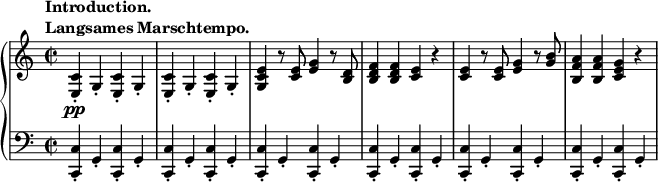
 \relative c' { \new PianoStaff << \new Staff { \key a \minor \time 2/2 \tempo \markup { \column { \line { Introduction. } \line { Langsames Marschtempo. } } } <c e,>-.\pp g4-. <c e,>-. g4-. <c e,>-. g4-. <c e,>-. g4-. <e' c g> r8 <e c>8 <e g>4 r8 <d b>8 <d b f'>4 <d b f'> <c e> r <c e> r8 <c e>8 <e g>4 r8 <g b>8 <a f b,>4 <a f b,> <g e c> r } \new Staff { \key a \minor \time 2/2 \clef bass <c,, c,>-. g4-. <c c,>-. g4-. <c c,>-. g4-. <c c,>-. g4-. <c c,>-. g4-. <c c,>-. g4-. <c c,>-. g4-. <c c,>-. g4-. <c c,>-. g4-. <c c,>-. g4-. <c c,>-. g4-. <c c,>-. g4-. } >> }

A quiet march starts the waltz's introduction before a sweeping crescendo heralds the gentle principal melody of the first waltz. As more waltz sections are introduced, the mood remains constantly upbeat and triumphant. A cello solo near the end of the work reprises the melody of the first waltz section, before a trumpet fanfare ushers the end of the work, complete with a drumroll on the timpani and a strong brass flourish.

Waltz 2
 \relative c' { \new PianoStaff << \new Staff { \key f \minor \time 3/4 \tempo \markup { \column { } } r <aes' aes'>-.( <aes aes'>-.) <aes aes'>( <g g'> c) <c f,>2.( <bes f>) r4 <g g'>4-.( <g g'>-.) <g g'>( <f f'> bes) <bes ees,>2.( <aes ees>) r4 f'4-.( f-.) f ( ees aes,) aes\mordent( g) aes bes2 } \new Dynamics { s\p } \new Staff { \key f \minor \time 3/4 \clef bass c,,4 <aes' ees'> <aes ees'> c, <aes' ees'> <aes ees'> des, <bes' des> <bes des> des, <bes' des> <bes des> bes, <bes' des> <bes des> ees, <g des'> <g des'> c, <ees c' aes> <ees c' aes> c <ees c' aes> <ees c' aes> aes, <aes' ees' c> <aes ees' c> aes, <aes' ees' c> <aes ees' c> ees <bes' des> <bes des> ees, } >> }

References

Based on original text by Peter Kemp, The Johann Strauss Society of Great Britain. Used with permission.

External links

This article is copied from an article on Wikipedia® - the free encyclopedia created and edited by its online user community. The text was not checked or edited by anyone on our staff. Although the vast majority of Wikipedia® encyclopedia articles provide accurate and timely information, please do not assume the accuracy of any particular article. This article is distributed under the terms of GNU Free Documentation License.

Copyright © 2003-2025 Farlex, Inc Disclaimer
All content on this website, including dictionary, thesaurus, literature, geography, and other reference data is for informational purposes only. This information should not be considered complete, up to date, and is not intended to be used in place of a visit, consultation, or advice of a legal, medical, or any other professional.
