| Hydrangea arborescens | |
|---|---|
) | |
Scientific classification  | |
| Kingdom: | Plantae |
| Clade: | Tracheophytes |
| Clade: | Angiosperms |
| Clade: | Eudicots |
| Clade: | Asterids |
| Order: | Cornales |
| Family: | Hydrangeaceae |
| Genus: | Hydrangea |
| Species: | H. arborescens |
| Binomial name | |
| Hydrangea arborescens L.[1] | |
Hydrangea arborescens, commonly known as smooth hydrangea, wild hydrangea, sevenbark, or in some cases, sheep flower, is a species of flowering plant in the family Hydrangeaceae. It is a small- to medium-sized, deciduous shrub up to 3 m (10 ft) tall that is native to the eastern United States.[2]
Characteristics
The inflorescence is a corymb. The showy, sterile flowers are usually absent or if present they are usually less than 1 cm in diameter.[2] Flowering occurs May to July. Fruit is a ribbed brown capsule about 2 mm long; many are produced.
The leaves are large (8 to 18 cm long), opposite, serrated, ovate, and deciduous. The lower leaf surface is glabrous or with inconspicuous fine hairs, appearing green; trichomes of the lower surface are restricted to the midrib and major veins.
The stem bark has a peculiar tendency to peel off in several successive thin layers with different colors, hence the common name "sevenbark".[3]
Smooth hydrangea can spread rapidly by stolons to form colonies.[4]
Taxonomy
At one time both ashy hydrangea (Hydrangea cinerea) and silverleaf hydrangea (Hydrangea radiata) were considered subspecies of smooth hydrangea.[5] However, most taxonomists now consider them to be separate species.[2][6]
Range and habitat
Smooth hydrangea is widely distributed across the eastern United States—from southern New York to the panhandle of Florida, west to eastern Oklahoma and southeastern Kansas. It is mainly found in moist soils under a hardwood forest canopy and is often common along woodland road banks and streams.[7] It is common in the Delaware River Valley and in the Appalachian Mountains.[2][3]
It is a host plant of the hydrangea sphinx moth.
Uses
This attractive native shrub is often cultivated for ornamental use.[8] 'Annabelle' is the best known cultivar of this species; it is one of the most cold hardy of the hydrangeas. In the UK it has gained the Royal Horticultural Society's Award of Garden Merit.[9][10] The cultivar 'Grandiflora' has flowers that resemble snowballs, similar to Viburnum plicatum.
Smooth hydrangea root was used medicinally by Native Americans, and later, by early settlers for treatment of kidney and bladder stones.[11][12]
Gallery

Annabelle Hydrangea Bloom. Hydrangea arborescens.
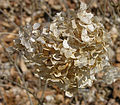
Hills-of-Snow Hydrangea "Grandiflora"

Wild Hydrangea v. Annabelle
Hydrangea arborescens.jpg)
Flowers of Smooth Hydrangea

Wild Hydrangea Flowers
)
)
)
.jpg'))
)
References
- ^ "USDA Natural Resources Conservation Services: Plant Profiles. Hydrangea arborescens L". Plants.usda.gov. Retrieved 2014-06-30.
- ^ a b c d "Weakley, Alan S. 2008 (working draft). Flora of Carolinas, Virginia, Georgia, northern Florida, and surrounding areas. University of North Carolina Herbarium". Herbarium.unc.edu. 2012-10-02. Retrieved 2014-06-30.
- ^ a b "Purdue University: Horticulture and Landscape Architecture. Smooth Hydrangea". Hort.purdue.edu. 1998-04-03. Retrieved 2014-06-30.
- ^ "Missouri Botanical Garden: Hydrangea arborescens". Mobot.org. Retrieved 2014-06-30.
- ^ McClintock, E. 1957. A monograph of the genus Hydrangea. Proceedings of the California Academy of Sciences 29: 147-256.
- ^ Pilatowski, Ronald E. A taxonomic study of the Hydrangea arborescens complex. Castanea 47: 84-98.
- ^ Lance, Ron. 2004 Woody Plants of the southeastern United States: A winter guide. The University of Georgia Press. 456 p.
- ^ Dirr, Michael A. hydrangeas for American gardens. Timber Press. 240 p.
- ^ "RHS Plantfinder - Hydrangea arborescens 'Annabelle'". Retrieved 7 March 2018.
- ^ "AGM Plants - Ornamental" (PDF). Royal Horticultural Society. July 2017. p. 51. Retrieved 7 March 2018.
- ^ "Mrs. M. Grieve. A Modern Herbal. Hydrangea arborescens". Botanical.com. Retrieved 2014-06-30.
- ^ "Plants for a Future: Hydrangea arborescens ;". pfaf.org. Retrieved 2015-12-23.
External links
- Cook, Will. Trees, shrubs, and woody vines of North Carolina. Wild Hydrangea (Hydrangea arborescens).
- Information on cultivar Annabelle
- Hydrangea arborescens Large-format diagnostic photos and information
- Hydrangea Thoughts I - Informative but non-scholarly essay on Hydrangea (Culture, History and Etymology).
- Briartech.com: Smooth Hydrangea, Hydrangea arborescens.