)
A pseudanthium (Greek for "false flower"), is an inflorescence that resembles a flower. The word is sometimes used for other structures that are neither a true flower nor a true inflorescence but that look like a flower.[1] Examples of pseudanthia include flower head, composite flower,[2]:514 or capitulum, which are special types of inflorescences[3] in which anything from a small cluster to hundreds or sometimes thousands of flowers are grouped together to form a single flower-like structure. Pseudanthia take various forms. The real flowers (the florets) are generally small and often greatly reduced, but the pseudanthium itself can sometimes be quite large (as in the heads of some varieties of sunflower).
Pseudanthia are characteristic of the daisy and sunflower family (Asteraceae), whose flowers are differentiated into ray flowers and disk flowers, unique to this family. The disk flowers in the center of the pseudanthium are actinomorphic and the corolla is fused into a tube. Flowers on the periphery are zygomorphic and the corolla has one large lobe (the so-called "petals" of a daisy are individual ray flowers, for example). Either ray or disk flowers may be absent in some plants: Senecio vulgaris lacks ray flowers[4] and Taraxacum officinale lacks disk flowers.[4][5] The pseudanthium has a whorl of bracts below the flowers, forming an involucre.
In all cases, a pseudanthium is superficially indistinguishable from a flower, but closer inspection of its anatomy will reveal that it is composed of multiple flowers. Thus, the pseudanthium represents an evolutionary convergence of the inflorescence to a reduced reproductive unit that may function in pollination like a single flower, at least in plants that are animal pollinated.
History
The term pseudanthium was originally applied to flowers with stamens in two whorls with the outer whorl opposite the petals (obdiplostemonate) or polyandric flowers; by the early 1900's the term was repurposed by the advocates of the 'pseudanthium theory' which assumed flower evolution originated from a polyaxail instead of a monoaxial configuration.[6]
Related terms
Synorganization
The collection of independent organs into a complex structure is called synorganization.[7]
Head
Head is an equivalent term for flower head and pseudanthium when used in the botanical sense
Capitulum
Capitulum (plural capitula) can be used as an exact synonym for pseudanthium and flower head; however, its use is generally but not always restricted to the family Asteraceae. At least one source defines it as a small flower head.[8] In addition to its botanical use as a term meaning flower head it is also used to mean the top of the sphagnum plant.[9]
Calathid
Calathid (plural calathids or calathidia) is a very rarely used term. It was defined in the 1966 book, The genera of flowering plants (Angiospermae), as a specific term for a flower head of a plant in the family Asteraceae.[3] However, on-line botanical glossaries do not define it, and Google Scholar does not link to any significant usage of the term in a botanical sense.
Plant families
)
Pseudanthia occur in the following plant families:
- Adoxaceae — in some Viburnum spp.
- Apiaceae — pseudanthia are called umbels
- Araceae — pseudanthia are called spadices
- Asteraceae
- Campanulaceae[10]
- Centrolepidaceae[10] — Where individual male and female flowers are grouped together and wrapped in bracts forming a pseudanthium appearing as a bisexual flower.[11]
- Cornaceae
- Cyperaceae — In subfamily Mapanioideae,[12] pseudanthia are termed spicoids.[13]
- Dipsacaceae
- Euphorbiaceae — pseudanthia are called cyathia,[14] composed of a single carpal flower with few to many single stamen staminate flowers contained within a cup-shaped structure or bracts; the bracts are often rimmed with nectaries and less commonly petal-like structures.[15] The central cyathia maybe composed of all male flowers.[16]
)
- Eriocaulaceae[10]
- Hamamelidaceae[10] — in Rhodoleia
- Moraceae[10]
- Myrtaceae — in Actinodium
- Nyssaceae — in Davidia[17]
- Poaceae[10]
- Pontederiaceae[10] — in Hydrothrix
- Proteaceae[10]
- Rubiaceae[10]
- Saururaceae[10] — in Anemopsis
In some families, it is not yet clear whether the "flower" represents a pseudanthium because the anatomical work has not been done (or is still ambiguous due to considerable evolutionary reduction). Possible pseudanthia of this type may occur in the following families:
The individual flowers of a pseudanthium in the family Asteraceae (or Compositae) are commonly called florets.[19]
Gallery

Diagram of a flower head. Note bracts surrounding the flowers, which would be absent on a capitulum.
.jpg)
Flower head of a common daisy (Bellis perennis)
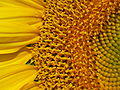
Flowers open in succession in head of a sunflower (Helianthus annuus), with ray florets forming the 'petals'

Close up of the ray corolla of a Hieracium lachenalii; every "petal" is actually a separate five-petaled flower complete with its own stamens and making its own fruit.

Discoid (having only disk flowers) flower heads of a rubber rabbitbrush.
)
.jpg'))
)
)
)
References
- ^ Louis P. Ronse De Craene. Floral Diagrams: An Aid to Understanding Flower Morphology and Evolution. Cambridge University Press; 4 February 2010. ISBN 978-1-139-48455-8. p. 23–.
- ^ Chester, Sharon (2016), The Arctic Guide: Wildlife of the Far North, Princeton University Press, ISBN 9781400865963.
- ^ a b Hutchinson, John (1964). The genera of flowering plants (Angiospermae). Oxford: Clarendon Press. LCCN 65000676.
- ^ a b "Senecio vulgaris L." Missouri Plants. Archived from the original on 27 June 2012. Retrieved 2 December 2012.
- ^ "Taraxacum Officinale". Florida Data. Retrieved 2 December 2012.
- ^ Elmar Robbrecht. Second International Rubiaceae Conference Proceedings. National Botanic Garden of Belgium; 1996. ISBN 978-90-72619-29-7. p. 330.
- ^ Developmental Genetics of the Flower: Advances in Botanical Research. Elsevier; 29 September 2006. ISBN 978-0-08-046463-3. p. 35–.
- ^ Harris, James (2001). Plant Identification Terminology An illustrated Glossary. Spring Lake. ISBN 978-0-9640221-6-4.
- ^ "Australian bryophytes". Retrieved 2012-02-26.
- ^ a b c d e f g h i j Rolf H. J. Schlegel. Dictionary of Plant Breeding. CRC Press; 22 July 2020. ISBN 978-1-00-006698-2. p. 459–.
- ^ Gwen Jean Harden. Flora of New South Wales. UNSW Press; 1990. ISBN 978-0-86840-188-1. p. 407–.
- ^ "Cyperaceae - Evolution and classification". Encyclopedia Britannica. Retrieved 2021-02-14.
- ^ Simpson, David A.; Furness, Carol A.; Hodkinson, Trevor R.; Muasya, A. Muthama; Chase, Mark W. (July 2003). "Phylogenetic relationships in Cyperaceae subfamily Mapanioideae inferred from pollen and plastid DNA sequence data". American Journal of Botany. 90 (7): 1071–1086. doi:10.3732/ajb.90.7.1071. ISSN 0002-9122. PMID 21659207.
- ^ Plant Ecology in the Middle East. OUP Oxford; 14 January 2016. ISBN 978-0-19-107873-6. p. 176–.
- ^ James L. Castner. Photographic Atlas of Botany and Guide to Plant Identification. Feline Press; 2004. ISBN 978-0-9625150-0-2. p. 145.
- ^ Chittaranjan Kole. Wild Crop Relatives: Genomic and Breeding Resources: Plantation and Ornamental Crops. Springer Science & Business Media; 1 September 2011. ISBN 978-3-642-21201-7. p. 125–.
- ^ Claßen-Bockhoff, R., Arndt, M. Flower-like heads from flower-like meristems: pseudanthium development in Davidia involucrata (Nyssaceae). J Plant Res 131, 443–458 (2018). https://doi.org/10.1007/s10265-018-1029-6
- ^ Petra Hoffmann, Hashendra S. Kathriarachchi, and Kenneth J. Wurdack. 2006. "A Phylogenetic Classification of Phyllanthaceae (Malpighiales)." Kew Bulletin. 61(1):40.
- ^ "calflora Botanical Terms". Retrieved 2012-02-26.