| Limbic lobe | |
|---|---|
) Inferomedial view of the left cerebral hemisphere showing the limbic lobe in areas 5-7. | |
| Details | |
| Identifiers | |
| Latin | lobus limbicus gyrus fornicatus |
| MeSH | D065726 |
| NeuroNames | 834 |
| NeuroLex ID | birnlex_1128 |
| TA98 | A14.1.09.230 |
| TA2 | 5507 |
| FMA | 72719 |
| Anatomical terms of neuroanatomy | |
The limbic lobe is an arc-shaped region of cortex on the medial surface of each cerebral hemisphere of the mammalian brain, consisting of parts of the frontal, parietal and temporal lobes. The term is ambiguous, with some authors including the paraterminal gyrus, the subcallosal area, the cingulate gyrus, the parahippocampal gyrus, the dentate gyrus, the hippocampus and the subiculum;[1] while the Terminologia Anatomica includes the cingulate sulcus, the cingulate gyrus, the isthmus of cingulate gyrus, the fasciolar gyrus, the parahippocampal gyrus, the parahippocampal sulcus, the dentate gyrus, the fimbrodentate sulcus, the fimbria of hippocampus, the collateral sulcus, and the rhinal sulcus, and omits the hippocampus.
History
Broca named the limbic lobe in 1878, identifying it with the cingulate and parahippocampal gyri, and associating it with the sense of smell - Treviranus having earlier noted that, between species, the size of the parahippocampal gyrus varies with the size of the olfactory nerve.[2] In 1937 Papez theorized that a neural circuit (the Papez circuit) including the hippocampal formation and the cingulate gyrus constitutes the neural substrate of emotional behavior,[3] and Klüver and Bucy reported that, in monkeys, resection involving the hippocampal formation and the amygdaloid complex has a profound effect on emotional responses.[4][5] As a consequence of these publications, the idea that the entire limbic lobe is dedicated to olfaction receded, and a direct connection between emotion and the limbic lobe was established.[6]
Gallery
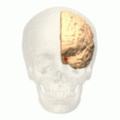
Limbic lobe (shown in red) of left cerebral hemisphere.
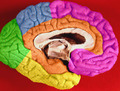
Limbic lobe (shown in orange) of left cerebral hemisphere.
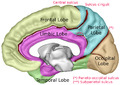
Limbic lobe (shown in purple) of right cerebral hemisphere.
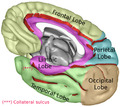
Limbic lobe (shown in purple) of right cerebral hemisphere.
)
)
)
)
References
- ^ Fix, JD (2008). "Gross anatomy of the brain". Neuroanatomy (fourth ed.). Philadelphia: Lippincott Williams & Wilkins. p. 6. ISBN 978-0-7817-7245-7.
- ^ Finger, S (2001). "Defining and controlling the circuits of emotion". Origins of neuroscience: a history of explorations into brain function. Oxford/New York: Oxford University Press. p. 286. ISBN 0-19-506503-4.
- ^ Papez, JW (1937). "A proposed mechanism of emotion". Archives of Neurology and Psychiatry. 38 (4): 725–43. doi:10.1001/archneurpsyc.1937.02260220069003.
- ^ Klüver, H; Bucy, PC (1937). ""Psychic blindness" and other symptoms following bilateral temporal lobectomy in Rhesus monkeys". American Journal of Physiology. 119: 352–53.
- ^ Klüver, H; Bucy, PC (1939). "Preliminary analysis of functions of the temporal lobes in monkeys". Archives of Neurology and Psychiatry. 42 (6): 979–1000. doi:10.1001/archneurpsyc.1939.02270240017001.
- ^ Nieuwenhuys, R; Voogd, J; van Huijzen, C (2008). "The greater limbic system". The human central nervous system (fourth ed.). Berlin/Heidelberg/New York: Springer-Verlag. p. 917. ISBN 978-3-540-13441-1.