Demand forecasting is a field of predictive analytics[1] which tries to understand and predict customer demand to optimize supply decisions by corporate supply chain and business management. Demand forecasting involves quantitative methods such as the use of data, and especially historical sales data, as well as statistical techniques from test markets. Demand forecasting may be used in production planning, inventory management, and at times in assessing future capacity requirements, or in making decisions on whether to enter a new market.
Methods
Qualitative assessment
Forecasting demand based on expert opinion. Some of the types in this method are,
- Unaided judgment
- Prediction market
- Delphi technique
- Game theory
- Judgmental bootstrapping
- Simulated interaction
- Intentions and expectations survey
- jury of executive method
Quantitative assessment
- Discrete event simulation
- Extrapolation
- Group method of data handling (GMDH)
- Reference class≈ forecasting
- Quantitative analogies
- Rule-based forecasting
- Neural networks
- Data mining
- Conjoint analysis
- Causal models
- Segmentation
- Exponential smoothing models
- Box–Jenkins models
- Hybrid models
Others are as follows
- Time series projection methods
 moving average
- Moving average method
- Exponential smoothing method
- Trend projection methods
- Causal methods
 leading indicator
- Chain-ratio method
- Consumption level method
- End use method
- Leading indicator method
)
)
Calculating demand forecast accuracy
Calculating demand forecast accuracy is the process of determining the accuracy of forecasts made regarding customer demand for a product.[2][3] Understanding and predicting customer demand is vital to manufacturers and distributors to avoid stock-outs and maintain adequate inventory levels. While forecasts are never perfect, they are necessary to prepare for actual demand. In order to maintain an optimized inventory and effective supply chain, accurate demand forecasts are imperative.
Calculating the accuracy of supply chain forecasts
Forecast accuracy in the supply chain is typically measured using the Mean Absolute Percent Error or MAPE. Statistically MAPE is defined as the average of percentage errors.
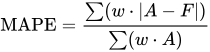
Most practitioners, however, define and use the MAPE as the Mean Absolute Deviation divided by Average Sales, which is just a volume weighted MAPE, also referred to as the MAD/Mean ratio. This is the same as dividing the sum of the absolute deviations by the total sales of all products. This calculation , where A is the actual value and F the forecast, is also known as WAPE, Weighted Absolute Percent Error.

Another interesting option is the weighted . The advantage of this measure is that could weight errors, so you can define how to weight for your relevant business, ex gross profit or ABC. The only problem is that for seasonal products you will create an undefined result when sales = 0 and that is not symmetrical, that means that you can be much more inaccurate if sales are higher than if they are lower than the forecast. So sMAPE is also used to correct this, it is known as symmetric Mean Absolute Percentage Error.
Last but not least, for intermittent demand patterns none of the above are really useful. So you can consider MASE (Mean Absolute Scaled Error) as a good KPI to use in those situations, the problem is that is not as intuitive as the ones mentioned before.[4]
Calculating forecast error
The forecast error needs to be calculated using actual sales as a base. There are several forms of forecast error calculation methods used, namely Mean Percent Error, Root Mean Squared Error, Tracking Signal and Forecast Bias.
See also
- Supply and demand
- Demand chain
- Demand Modeling
- Inventory § Principle of inventory proportionality
- Reference class forecasting
- Consensus forecasts
- Optimism bias
- Reference class forecasting
References
- ^ Overview
- ^ Hyndman, R.J., Koehler, A.B (2005) " Another look at measures of forecast accuracy", Monash University.
- ^ Hoover, Jim (2009) "How to Track Forecast Accuracy to Guide Process Improvement", Foresight: The International Journal of Applied Forecasting.
- ^ You can find an interesting discussion here.
Bibliography
- Milgate, Murray (March 2008). "Goods and commodities". In Steven N. Durlauf and Lawrence E. Blume. The New Palgrave Dictionary of Economics (2nd ed.). Palgrave Macmillan. pp. 546–48. doi:10.1057/9780230226203.0657. Retrieved 2010-03-24.
- Montani, Guido (1987). "Scarcity". In Eatwell, J. Millgate, M., Newman, P. The New Palgrave. A Dictionary of Economics 4. Palgrave, Houndsmill. pp. 253–54.